
20% of the World's Oil Goes Through a Strait That's Been Basically Shut For 10 Weeks. Here's What It Means for Your Money.
The Strait of Hormuz crisis is the biggest energy supply shock in history. Wall Street is shrugging — but the math says that can't last forever. Here's a number to let sink in: one billion barrels of oil. That's roughly how much crude the world has already lost — or will lose…
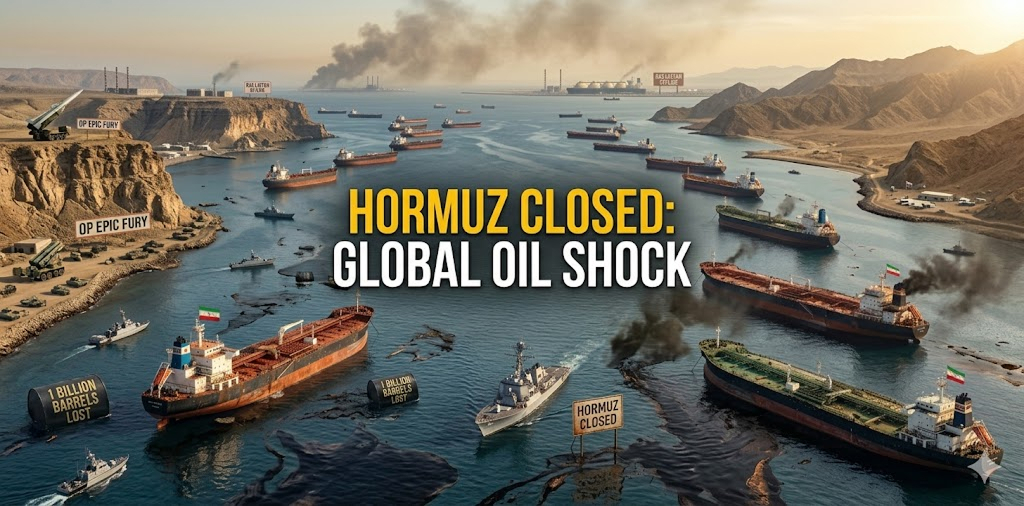
The Strait of Hormuz crisis is the biggest energy supply shock in history. Wall Street is shrugging — but the math says that can't last forever.
Here's a number to let sink in: one billion barrels of oil.
That's roughly how much crude the world has already lost — or will lose before this is over — because a narrow stretch of water between Iran and the Arabian Peninsula has been effectively shut since late February. That's the estimate from Russell Hardy, CEO of Vitol, the world's largest independent oil trader. Speaking at the FT Commodities Global Summit in late April, Hardy put it plainly: "In round numbers, the 1 billion barrels is baked in now. By the time things get moving again, it takes time to bring it all back."
This is the energy story investors aren't paying nearly enough attention to — and the one that could matter most to their portfolios before the year is out.
🛢️ What Actually Happened
On February 28, the United States and Israel launched coordinated airstrikes on Iran under Operation Epic Fury. Iran responded by closing the Strait of Hormuz — a narrow 21-mile-wide passage connecting the Persian Gulf to the open ocean — to most foreign shipping. It's a chokepoint so critical that before the war, roughly 25% of the world's seaborne oil trade and 20% of its liquefied natural gas (LNG) passed through it every day.
The International Energy Agency called what followed the "largest supply disruption in the history of the global oil market." Crude oil flows through the Strait plunged from around 20 million barrels per day before the war to just over 2 million in March. Gulf producers including Saudi Arabia, Iraq, Kuwait, and the UAE were forced to cut total oil production by more than 14 million barrels per day — not because they ran out of oil, but because tankers couldn't leave.
There's no easy workaround. Only Saudi Arabia and the UAE have pipelines capable of routing oil around the Strait, with a combined bypass capacity of just 3.5 to 5.5 million barrels per day — a fraction of what the world needs.
💡 Investor Signal: This Isn't Just an Energy Story
The Strait of Hormuz doesn't only carry oil. It also accounts for one-third of global seaborne fertilizer trade and about 40% of the world's helium supply — a critical ingredient in semiconductor manufacturing. According to IEEFA, one-quarter of global LNG export capacity has been offline since the crisis began, with Qatar's Ras Laffan facility — the largest liquefaction plant on earth — still not fully operational after being struck in early March.
That means the ripple effects run from your gas tank to your grocery bill to the chips inside your smartphone.
In Europe, the blow has been especially acute. Dutch TTF gas benchmarks nearly doubled to over €60 per megawatt-hour by mid-March. Economists at the IMF are now projecting euro area growth of just over 1% for 2026 — down from 1.4% before the war — and warn that a prolonged disruption risks tipping the continent into recession.
Aneet Sen, an energy analyst interviewed by CNBC, offered a sobering read on what comes next. "Just wait for food prices to start going up because of what's going on — the lack of urea transport, and natural gas being curtailed in the fertilizer sector," she said. She added that she now expects $80 to $90 per barrel to be "the new floor going forward" for Brent crude, regardless of whether the Strait reopens.
📊 So Why Is the Stock Market at All-Time Highs?
The S&P 500 hit a record 7,398 last Friday. The Nasdaq is at 26,247. It seems like a contradiction — and in some ways it is. But there are real reasons why U.S. equities have largely shrugged off the worst energy shock in history, along with some important caveats to each of them.
The most common argument is that the United States, as the world's largest oil producer, is somewhat insulated. That's partially true — but oil is a fungible global commodity. When Brent crude spikes due to the Hormuz blockade, WTI (the U.S. benchmark) follows it higher. Americans still pay global prices at the pump, and a sustained gas price shock has historically triggered consumer spending slowdowns and political backlash regardless of how much the U.S. produces domestically.
The second argument is that AI and tech — the companies actually driving the index higher — run on data centers, not crude oil, so energy prices shouldn't hit their earnings. Also partially true, but with a catch: those data centers run on electricity, and a growing share of U.S. electricity generation relies on natural gas. European TTF gas benchmarks have already nearly doubled. If that dynamic migrates to U.S. power markets, the operating costs of the infrastructure underpinning the AI boom start to climb in ways that aren't yet priced into forward earnings estimates. And if the macro deterioration the crisis threatens tips enterprise customers into cutting budgets, even Microsoft's recurring software revenue isn't fully immune.
Then there's the reopening illusion. OilPrice.com analysis points out that even when the Strait technically "reopens," the system won't just snap back. Vessel traffic has at times fallen 90% from normal levels — real-time shipping data has shown as few as three tankers transiting per day, against a normal 120 to 140. Wells have been shut in. Infrastructure has been damaged. Iraq alone could take up to nine months to restore prior production levels once flows resume, according to Wood Mackenzie's Head of Upstream Analysis, Fraser McKay.
As Hardy put it at the FT Summit: "The restart of production, the restart of refineries — there's an awful lot of infrastructure that's been shut down. It takes some time to put all of that back."
🗓️ The Wildcard: This Week's Trump-Xi Summit
The biggest near-term catalyst for the Hormuz story lands Thursday and Friday — the Trump-Xi summit in Beijing. China is the world's largest buyer of Gulf oil, and the Strait's closure has already dealt a direct economic blow to Beijing. In the run-up to the summit, China pressed Iran to reopen shipping routes and pursue a diplomatic resolution. Whether that pressure translates into real movement on the ground is the question every energy investor is watching.
A diplomatic breakthrough — or even credible progress toward one — could send oil prices lower and relieve inflation pressures globally. A summit that produces nothing changes the math for how much longer the world's supply chains can absorb this shock.
Gunvor's head of trading told the FT Commodities Summit: "If you don't get any reopening in three months' time, then the case becomes a macro issue where the world is about to fall into recession. And then you have massive demand adjustment."
Three months from the February 28 closure is May 28. We are weeks away from that threshold.
🍽️ The Bottom Line for Investors
The stock market's resilience in the face of this crisis is genuinely impressive — and for now, partly justified. But the longer the Strait stays disrupted, the harder it becomes for markets to keep looking the other way. The buffer that's held things together — emergency oil stock releases, alternative routing, and full strategic reserves — isn't unlimited. Hardy said it himself: "You can't do that forever."
For investors, the practical takeaway: energy stocks and inflation-protected securities like TIPS have performed well and remain reasonable hedges. Consumer discretionary names — particularly airlines, shipping-dependent retailers, and food producers reliant on fertilizer — face cost pressure that hasn't fully shown up in earnings yet. If you're long on those names right now, you are, in effect, betting on a diplomatic breakthrough in Beijing this Friday.
That might happen. The Trump-Xi summit is genuinely the most important geopolitical meeting of 2026. But the smart move is to know what you're betting on — and to remember that the wild card that could move everything else this year isn't a Fed decision or an earnings report. It's a 21-mile-wide stretch of water between Iran and Oman that's barely open for business.
Sources
- Argus Media — "Iran war cuts global oil demand by 4mn b/d: Vitol" (April 2026): https://www.argusmedia.com/en/news-and-insights/latest-market-news/2816982-iran-war-cuts-global-oil-demand-by-4mn-b-d-vitol
- OilPrice.com — "The Strait of Hormuz May Reopen, But the System Has Already Broken" (April 2026): https://oilprice.com/Energy/Energy-General/The-Strait-of-Hormuz-May-Reopen-But-the-System-Has-Already-Broken.html
- OilPrice.com — "The Oil Supply Shock Will Scar the World for Years" (April 2026): https://oilprice.com/Energy/Crude-Oil/The-Oil-Supply-Shock-Will-Scar-the-World-for-Years.html
- International Energy Agency — "The Middle East and Global Energy Markets" (2026): https://www.iea.org/topics/the-middle-east-and-global-energy-markets
- IEEFA — "Impact of Middle East Crisis on Global Energy Markets" (2026): https://ieefa.org/impact-middle-east-crisis-global-energy-markets
- UNCTAD — "Strait of Hormuz Disruptions: Implications for Global Trade and Development" (March 2026): https://unctad.org/publication/strait-hormuz-disruptions-implications-global-trade-and-development
- CNBC — "Stock market 'euphoria' masks looming Iran war recession risk" (May 4, 2026): https://www.cnbc.com/2026/05/04/strait-hormuz-gas-price-oil-shock-recession-risk-economy-iran-us-war.html
- Rigzone — "Oil Traders Warn of Recession Impact" (April 2026): https://www.rigzone.com/news/wire/oil_traders_warn_of_recession_impact-21-apr-2026-183500-article/
- The Motley Fool — "Strait of Hormuz Crisis: How Markets Have Handled the 'Largest Oil Supply Disruption in History' So Far" (April 23, 2026): https://www.fool.com/investing/2026/04/23/strait-of-hormuz-crisis-not-portfoli/
Market Munchies and Mode Mobile communications are for informational purposes only, and are not a recommendation, solicitation, or research report relating to any investment strategy, security, or digital asset. All investments involve risk including the loss of principal and past performance does not guarantee future results.
Any information contained in this commentary does not purport to be a complete description of the securities, markets, or developments referred to in this material. The information has been obtained from sources considered to be reliable, but we do not guarantee that the foregoing material is accurate or complete. There is no guarantee that any statements or opinions provided herein will prove to be correct.