
$4.50 Gas Is Splitting Restaurants Into Winners and Losers. Here's Where Every Major Chain Stands.
Wingstop Lost 8.7% of Same-Store Sales. Taco Bell Grew 8%. Same Energy Shock. Very Different Outcomes. The U.S. restaurant industry isn't slowing down evenly. It's splitting — and the clearest way to predict which chains are winning and which are losing is to ask one question:…
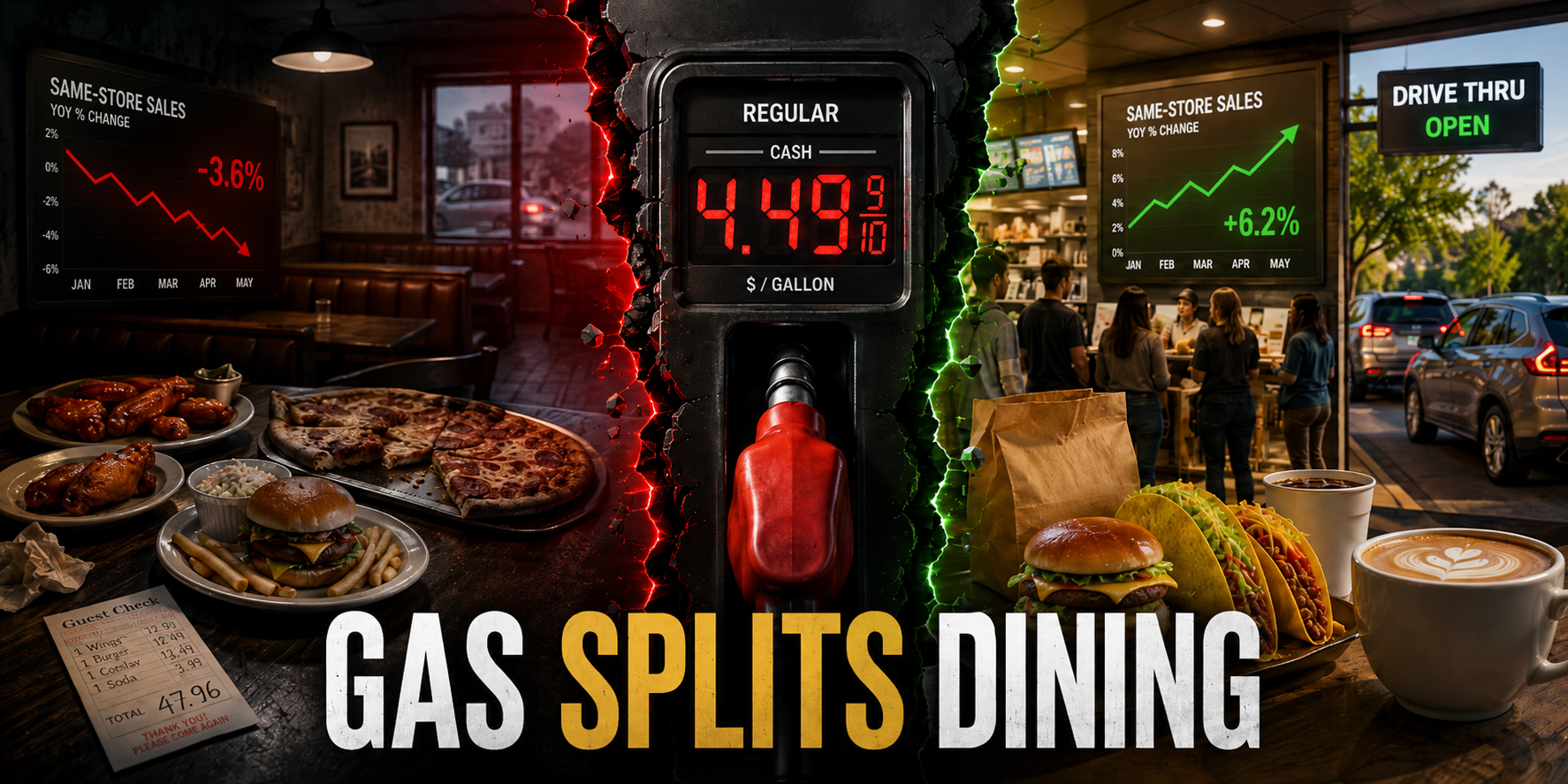
Wingstop Lost 8.7% of Same-Store Sales. Taco Bell Grew 8%. Same Energy Shock. Very Different Outcomes.
The U.S. restaurant industry isn't slowing down evenly. It's splitting — and the clearest way to predict which chains are winning and which are losing is to ask one question: does their typical customer have money left over after filling up the tank?
With gas averaging around $4.50 nationally and above $6 in California, the Iran war's energy shock has become one of the biggest forces reshaping where Americans eat in 2026. It's not the only thing that matters — food costs, staffing, local competition, and how well a brand executes all play a role — but it's the variable that restaurant CEOs keep bringing up on their own, without being asked. Research from Revenue Management Solutions finds that $4 a gallon is the tipping point: below that, gas costs are a nuisance; above it, people start skipping restaurant visits at twice the rate. We're well past $4. The earnings data from the past two weeks tells you who's absorbing that shock and who isn't.
📉 The Losers: Who's Getting Hurt
Wingstop: -8.7% same-store sales. Wingstop said higher fuel prices hurt sales badly — though analysts think gas prices and weather-related store closures explain about 4 percentage points of the 8.7% decline, not all of it. The CEO called the environment "extremely difficult to predict" and warned things could stay rough for the rest of the year. What makes this result striking is that Wingstop pitches itself as affordable. When even the budget chains are losing customers, it's a sign that some people simply don't have money to spend eating out right now — regardless of the price on the menu.
Domino's: +0.9% same-store sales — well below expectations. Domino's CEO noted that competitors started running promotions "out of our playbook," which cut into Domino's own sales growth. The chain still grew, but only barely — and it lowered its full-year sales forecast. That's a worrying sign for a brand built on affordable delivery, especially in an environment where more people are eating at home anyway.
Applebee's and IHOP (Dine Brands): sequential decline in March and April. "March and April were softer than January and February, particularly with this value-oriented consumer that we saw staying home more often or dining at lower-cost alternatives, and we attribute that to gas prices specifically and the economy more generally," said John Peyton, CEO of Dine Brands. He noted that when gas prices start to go past $3.50, "that affects that guest for us." At $4.52 nationally and $6+ in California, Dine Brands is operating more than a dollar above the threshold its own CEO says causes measurable traffic damage.
Industry-wide: restaurant visits down 2.3% in March. Overall restaurant traffic fell 2.3% in March compared to a year earlier, according to Black Box Intelligence. In April, nearly twice as many restaurant analysts cut their profit forecasts as raised them.
📈 The Winners: Who's Gaining — and Why
Taco Bell (Yum! Brands): +8% same-store sales. Taco Bell launched a value menu starting at $3 in January and posted 8% sales growth at U.S. locations. High gas prices helped by steering budget-conscious customers toward cheaper options, but Taco Bell's win isn't just about price — the brand has also been putting out new drinks, leaning into digital ordering, and refreshing its menu. The low prices opened the door; solid execution is what walked customers through it.
McDonald's: +3.9% U.S. same-store sales, +3.7% globally. McDonald's sales at restaurants open at least a year rose 3.7% globally, with U.S. locations up 3.9%. The chain has been running two plays at once: deeply discounted meals for customers watching their budgets and full-priced promotions for those who aren't. In April it added a new menu of items under $3 and a $4 breakfast deal. CEO Chris Kempczinski was blunt: "When you have elevated gas prices, that is going to disproportionately impact low-income consumers. And so we expect the pressures there are going to continue."
Burger King (Restaurant Brands International): +5.8% U.S. same-store sales. Burger King outpaced both McDonald's and Wendy's in the U.S. this quarter. The company's CEO said the results were more about internal execution than external tailwinds — which may be true, but Burger King's affordable menu is clearly benefiting from customers who are looking for cheaper options right now.
Starbucks: +7.1% same-store sales in North America. Starbucks had a strong quarter and may have benefited from the gloomy economic mood. CEO Brian Niccol said the company gained lower-income customers who saw Starbucks as "a little bit of indulgence." When people can't afford a dinner out, a $6 latte can feel like the treat they're still allowed. One thing to watch: Starbucks' profit growth hasn't quite kept up with its sales growth. Margins are still being squeezed by labor costs and operational changes under Niccol — so strong sales don't automatically translate to strong earnings.
Chili's (Brinker International): gaining market share. Chili's CEO Kevin Hochman said "we have seen our market share accelerate, which obviously means the casual-dining industry is shrinking or slowing down." Chili's has been one of the more aggressive value repositioning stories in casual dining, and it's paying off — even as the overall category struggles.
🔬 The $4 Threshold — and What Happens Next
Research suggests that at around $4.20 per gallon, restaurant visits drop by roughly 1.5%. Above $5, the decline at fast-food chains could reach around 3%. The national average is hovering near $4.50, with parts of California well above $6.
That puts the industry in uncomfortable middle ground — hurting, but not yet at the worst-case level. If the Iran ceasefire holds and oil prices stabilize, the damage may not get much worse. If it collapses — Trump called it "on life support" this morning — and oil climbs back toward $120, the industry could see that full 3% decline play out.
Kraft Heinz CEO Steve Cahillane described the situation for lower-income households bluntly: "They're literally running out of money at the end of the month. We're seeing negative cash flows in the lower-income brackets where they're dipping into savings." That's the customer Wingstop, Domino's, and Applebee's most need to get back — and they won't until gas gets cheaper.
💼 What to Watch
For McDonald's, Taco Bell, and Burger King: Value is working. But McDonald's own CFO warned that food and packaging costs are rising in the "low single-digit" range this year, and those costs will eventually squeeze margins. Winning on customer counts today doesn't guarantee winning on profit tomorrow.
For Wingstop, Domino's, and casual dining broadly: The core problem is a customer who's spent too much on gas to have much left for food. That doesn't improve until gas prices do. A peace deal in Iran matters more to these chains right now than any new menu item or promotion.
For Starbucks: The "affordable indulgence" thesis is one of the more interesting stories in the sector right now. The next quarter's results will tell us whether lower-income customers who switched to Starbucks actually stuck around — or whether it was a one-time thing.
The restaurant industry's gas-price problem will not be solved by a value menu alone. For the weakest chains, real relief probably has to start at the pump.
Sources
- CNBC — "High gas prices are hurting restaurant sales — but not all chains": https://www.cnbc.com/2026/05/11/gas-prices-hurt-restaurant-spending-at-dominos-applebees.html
- Yahoo Finance / Reuters — "Rising gas prices are crushing restaurant sales as $4 a gallon becomes tipping point for consumers": https://finance.yahoo.com/economy/articles/rising-gas-prices-crushing-restaurant-204641133.html
- Honolulu Star-Advertiser / Reuters — "Gas prices surge as Iran war hits U.S. restaurant spending": https://www.staradvertiser.com/2026/05/04/breaking-news/gas-prices-surge-as-iran-war-hits-u-s-restaurant-spending/
- Bloomberg — "Gas Prices Hit Record High, Hurting Consumer Spending, CEOs Warn": https://www.bloomberg.com/news/articles/2026-05-07/gas-prices-hit-record-high-hurting-consumer-spending-ceos-warn
- Spokesman-Review / NYT — "Fast-food sales rise despite higher gas prices": https://www.spokesman.com/stories/2026/may/07/fast-food-sales-rise-despite-higher-gas-prices/
- GoInvest — "Restaurant Stocks Diverge as High Gas Prices Pressure Consumer Spending": https://goinvest.com/2026/05/11/restaurant-stocks-diverge-as-high-gas-prices-pressure-consumer-spending/
- YourNews — "High Gas Prices Hit Restaurant Sales as Consumers Pull Back on Spending": https://yournews.com/2026/05/05/6890169/high-gas-prices-hit-restaurant-sales-as-consumers-pull-back/
Market Munchies and Mode Mobile communications are for informational purposes only, and are not a recommendation, solicitation, or research report relating to any investment strategy, security, or digital asset. All investments involve risk including the loss of principal and past performance does not guarantee future results.
Any information contained in this commentary does not purport to be a complete description of the securities, markets, or developments referred to in this material. The information has been obtained from sources considered to be reliable, but we do not guarantee that the foregoing material is accurate or complete. There is no guarantee that any statements or opinions provided herein will prove to be correct.