
$50 Million Lost in Address Poisoning Attack: Trader's Costly Copy-Paste Mistake
🚨 How a Small Test Transaction Became a $50 Million Trap A cryptocurrency trader lost nearly $50 million in USDT after falling victim to an address poisoning attack on December 20, 2025. According to blockchain security firm Scam Sniffer, the incident began when the victim…
🚨 How a Small Test Transaction Became a $50 Million Trap
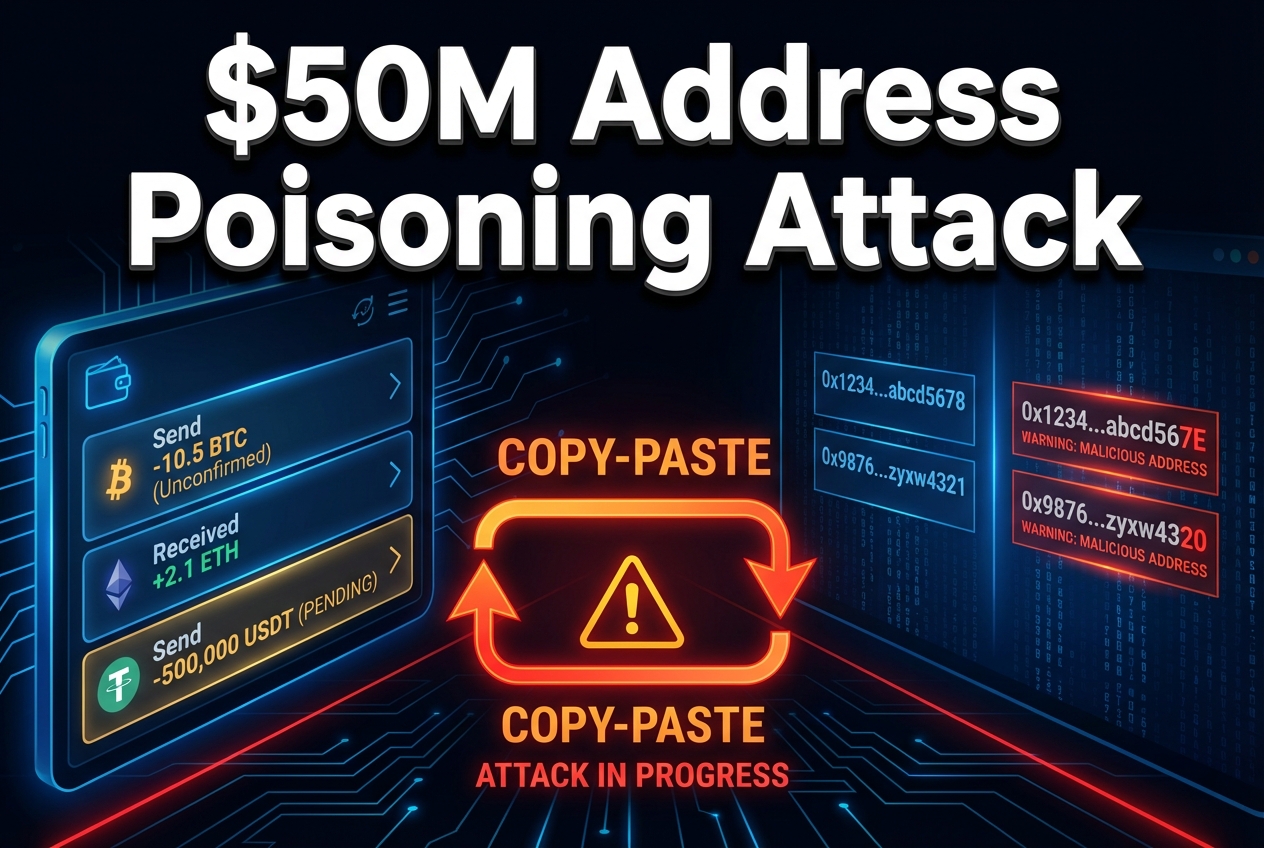
A cryptocurrency trader lost nearly $50 million in USDT after falling victim to an address poisoning attack on December 20, 2025. According to blockchain security firm Scam Sniffer, the incident began when the victim sent a small $50 test transaction to verify the correct wallet address. This standard security practice ironically triggered an automated attack script that immediately generated a spoofed wallet address matching the first three and last four characters of the victim's legitimate address. The attacker then sent a negligible amount of cryptocurrency from the fraudulent address to the victim's wallet, effectively poisoning the transaction history. When the trader returned to complete the main transfer of 49,999,950 USDT, they copied the address from their transaction history rather than the original source. Because most wallet interfaces truncate addresses with ellipses, the fake address appeared legitimate at first glance. The funds were sent instantly and irreversibly to the attacker's wallet. For traders managing large sums, this incident underscores how even following best practices can backfire when attackers exploit wallet design flaws.
⚙️ The Technical Mechanics Behind Address Poisoning
Address poisoning exploits human behavior rather than blockchain vulnerabilities. Attackers use vanity address generators powered by GPUs to create wallet addresses that mimic the first and last characters of target addresses. In 2025 alone, confirmed losses exceeded $83 million from these attacks, with individual incidents reaching up to $68 million. The attack relies on wallet interfaces that abbreviate long address strings for usability, showing only the beginning and end characters. Most users verify addresses by checking these visible portions, a habit attackers systematically abuse. The sophistication has escalated significantly, with plug-and-play attack toolkits now available on the dark web, enabling even novice hackers to execute high-stakes fraud. Ethereum accounts for 91% of address poisoning events, with stablecoins like USDT and USDC being the most targeted assets. The technical barrier to entry has dropped dramatically, as automated scripts can monitor blockchain activity and deploy spoofed addresses within seconds of detecting test transactions. For developers building wallet interfaces, this trend highlights an urgent need to redesign how addresses are displayed and verified.
💸 Following the Money: Tornado Cash and Recovery Challenges
After stealing the USDT, the attacker moved quickly to prevent asset seizure. On-chain records tracked by blockchain security firm SlowMist show the attacker immediately swapped the stolen USDT for DAI stablecoin using MetaMask Swap, since USDT can be frozen by its issuer. The funds were then converted into approximately 16,680 ETH and deposited into Tornado Cash, a decentralized mixing service designed to sever the visible link between sending and receiving addresses. Despite Tornado Cash facing legal challenges and sanctions in some jurisdictions, it remains operational and continues to be used for obfuscating transaction trails. The victim sent an on-chain message offering a $1 million white-hat bounty in return for 98% of the stolen funds, warning of criminal cases and international law enforcement cooperation. However, once funds enter privacy mixers like Tornado Cash, recovery becomes extremely unlikely without immediate action from exchanges or validators. The incident demonstrates the persistent cat-and-mouse game between blockchain transparency and privacy tools that enable both legitimate privacy and criminal money laundering.
🛡️ Prevention Strategies and Wallet Security Measures
Security experts recommend a multi-layered defense approach against address poisoning attacks. Hardware wallets and multi-signature wallets provide critical barriers against unauthorized transactions, while address whitelisting restricts transfers to pre-approved addresses only. Some modern wallets now warn users about address poisoning or flag addresses that closely resemble known ones, though adoption remains inconsistent across the industry. On-chain analytics platforms like Nansen and BlockSec offer real-time monitoring of wallet activity, flagging suspicious patterns and tracking blacklisted addresses. Users should generate fresh addresses for each transaction to minimize exposure and avoid sharing public addresses unnecessarily. Perhaps most importantly, users should bookmark legitimate financial institution websites rather than relying on search engine results, which can be manipulated through SEO poisoning tactics. The FBI Internet Crime Complaint Center received over 5,100 complaints reporting account takeover fraud since January 2025, with losses exceeding $262 million. For investors and traders, treating address management as a critical component of risk mitigation is no longer optional but existential to protecting digital assets.
🏛️ Industry Response and Regulatory Developments
The growing threat of address poisoning has prompted regulatory frameworks to emphasize investor protection more heavily. The U.S. GENIUS Act and the EU's Markets in Crypto-Assets regulation have introduced standards for stablecoin reserves and cross-border coordination. The Financial Action Task Force Travel Rule, nearing full implementation, now mandates virtual asset service providers to exchange customer information to prevent illicit activity. These regulatory measures aim to create a more transparent ecosystem, though challenges remain in balancing innovation with security. Wallet providers face mounting pressure to redesign user interfaces that currently prioritize visual simplicity over security verification. Industry analysts argue that wallet interfaces abbreviating address strings create a persistent vulnerability that attackers will continue to exploit until fundamental design changes are implemented. Some exchanges have begun implementing additional verification steps for large transfers, including mandatory waiting periods and multi-channel confirmation requirements. For institutional investors entering the crypto space, understanding these regulatory developments and security standards has become essential for due diligence and risk assessment when selecting custodial and non-custodial wallet solutions.
🎯 Lessons for Traders and the Path Forward
This $50 million loss serves as a stark reminder that human error remains the weakest link in crypto security, regardless of how sophisticated the underlying blockchain technology becomes. The victim followed standard security protocol by testing with a small transfer, yet that very action provided the attack vector. Address poisoning is widely known and frequently discussed, but the scale of this incident shocked analysts because it demonstrates how even experienced users can fall into predictable patterns under time pressure. Just seconds spent copying the address from the original source rather than transaction history would have prevented the loss entirely. The speed of blockchain finality left no window for reversal once the transaction was broadcast. Looking ahead, the industry must prioritize user experience design that accounts for real-world human behavior rather than assuming perfect vigilance. For traders and investors, this incident reinforces that complacency around security practices can result in catastrophic and irreversible losses. The combination of technological solutions like hardware wallets, regulatory oversight, and fundamental wallet interface redesigns will be essential to mitigating this evolving threat in the years ahead.
Sources
https://coinness.com/en/news/1146025 https://www.bitget.com/amp/news/detail/12560605118971 https://www.kucoin.com/news/flash/crypto-trader-loses-50m-in-address-poisoning-attack https://www.tradingview.com/news/cointelegraph:6388fff22094b:0-how-a-single-copy-paste-mistake-cost-a-user-50m-in-usdt/ https://www.ainvest.com/news/address-poisoning-attacks-impact-crypto-security-navigating-investment-risk-post-address-reuse-era-2512/ **2 Alternative Headlines:** 1. Address Poisoning Scam Steals $50M From Trader Who Followed Security Protocol 2. Copy-Paste Error Costs Crypto Trader Nearly $50 Million in Sophisticated Attack **2 Call to Actions:** 1. Learn how to protect your crypto assets from address poisoning attacks that have stolen over $83 million in 2025 alone. 2. Discover why following standard security practices isn't enough and what traders need to do differently to prevent costly address poisoning scams. **1 Paragraph Teaser Summary:** A cryptocurrency trader lost $50 million in USDT after copying a fraudulent wallet address from their transaction history in what security experts are calling one of the costliest address poisoning attacks on record. The victim followed standard protocol by sending a small test transaction first, but that action triggered an automated attack script that generated a lookalike address and poisoned the transaction history. The stolen funds were quickly swapped for ETH and sent to Tornado Cash, making recovery nearly impossible. With address poisoning
🚨 How a Small Test Transaction Became a $50 Million Trap
A cryptocurrency trader lost nearly $50 million in USDT after falling victim to an address poisoning attack on December 20, 2025. According to blockchain security firm Scam Sniffer, the incident began when the victim sent a small $50 test transaction to verify the correct wallet address. This standard security practice ironically triggered an automated attack script that immediately generated a spoofed wallet address matching the first three and last four characters of the victim's legitimate address. The attacker then sent a negligible amount of cryptocurrency from the fraudulent address to the victim's wallet, effectively poisoning the transaction history. When the trader returned to complete the main transfer of 49,999,950 USDT, they copied the address from their transaction history rather than the original source. Because most wallet interfaces truncate addresses with ellipses, the fake address appeared legitimate at first glance. The funds were sent instantly and irreversibly to the attacker's wallet. For traders managing large sums, this incident underscores how even following best practices can backfire when attackers exploit wallet design flaws.
⚙️ The Technical Mechanics Behind Address Poisoning
Address poisoning exploits human behavior rather than blockchain vulnerabilities. Attackers use vanity address generators powered by GPUs to create wallet addresses that mimic the first and last characters of target addresses. In 2025 alone, confirmed losses exceeded $83 million from these attacks, with individual incidents reaching up to $68 million. The attack relies on wallet interfaces that abbreviate long address strings for usability, showing only the beginning and end characters. Most users verify addresses by checking these visible portions, a habit attackers systematically abuse. The sophistication has escalated significantly, with plug-and-play attack toolkits now available on the dark web, enabling even novice hackers to execute high-stakes fraud. Ethereum accounts for 91% of address poisoning events, with stablecoins like USDT and USDC being the most targeted assets. The technical barrier to entry has dropped dramatically, as automated scripts can monitor blockchain activity and deploy spoofed addresses within seconds of detecting test transactions. For developers building wallet interfaces, this trend highlights an urgent need to redesign how addresses are displayed and verified.
💸 Following the Money: Tornado Cash and Recovery Challenges
After stealing the USDT, the attacker moved quickly to prevent asset seizure. On-chain records tracked by blockchain security firm SlowMist show the attacker immediately swapped the stolen USDT for DAI stablecoin using MetaMask Swap, since USDT can be frozen by its issuer. The funds were then converted into approximately 16,680 ETH and deposited into Tornado Cash, a decentralized mixing service designed to sever the visible link between sending and receiving addresses. Despite Tornado Cash facing legal challenges and sanctions in some jurisdictions, it remains operational and continues to be used for obfuscating transaction trails. The victim sent an on-chain message offering a $1 million white-hat bounty in return for 98% of the stolen funds, warning of criminal cases and international law enforcement cooperation. However, once funds enter privacy mixers like Tornado Cash, recovery becomes extremely unlikely without immediate action from exchanges or validators. The incident demonstrates the persistent cat-and-mouse game between blockchain transparency and privacy tools that enable both legitimate privacy and criminal money laundering.
🛡️ Prevention Strategies and Wallet Security Measures
Security experts recommend a multi-layered defense approach against address poisoning attacks. Hardware wallets and multi-signature wallets provide critical barriers against unauthorized transactions, while address whitelisting restricts transfers to pre-approved addresses only. Some modern wallets now warn users about address poisoning or flag addresses that closely resemble known ones, though adoption remains inconsistent across the industry. On-chain analytics platforms like Nansen and BlockSec offer real-time monitoring of wallet activity, flagging suspicious patterns and tracking blacklisted addresses. Users should generate fresh addresses for each transaction to minimize exposure and avoid sharing public addresses unnecessarily. Perhaps most importantly, users should bookmark legitimate financial institution websites rather than relying on search engine results, which can be manipulated through SEO poisoning tactics. The FBI Internet Crime Complaint Center received over 5,100 complaints reporting account takeover fraud since January 2025, with losses exceeding $262 million. For investors and traders, treating address management as a critical component of risk mitigation is no longer optional but existential to protecting digital assets.
🏛️ Industry Response and Regulatory Developments
The growing threat of address poisoning has prompted regulatory frameworks to emphasize investor protection more heavily. The U.S. GENIUS Act and the EU's Markets in Crypto-Assets regulation have introduced standards for stablecoin reserves and cross-border coordination. The Financial Action Task Force Travel Rule, nearing full implementation, now mandates virtual asset service providers to exchange customer information to prevent illicit activity. These regulatory measures aim to create a more transparent ecosystem, though challenges remain in balancing innovation with security. Wallet providers face mounting pressure to redesign user interfaces that currently prioritize visual simplicity over security verification. Industry analysts argue that wallet interfaces abbreviating address strings create a persistent vulnerability that attackers will continue to exploit until fundamental design changes are implemented. Some exchanges have begun implementing additional verification steps for large transfers, including mandatory waiting periods and multi-channel confirmation requirements. For institutional investors entering the crypto space, understanding these regulatory developments and security standards has become essential for due diligence and risk assessment when selecting custodial and non-custodial wallet solutions.
🎯 Lessons for Traders and the Path Forward
This $50 million loss serves as a stark reminder that human error remains the weakest link in crypto security, regardless of how sophisticated the underlying blockchain technology becomes. The victim followed standard security protocol by testing with a small transfer, yet that very action provided the attack vector. Address poisoning is widely known and frequently discussed, but the scale of this incident shocked analysts because it demonstrates how even experienced users can fall into predictable patterns under time pressure. Just seconds spent copying the address from the original source rather than transaction history would have prevented the loss entirely. The speed of blockchain finality left no window for reversal once the transaction was broadcast. Looking ahead, the industry must prioritize user experience design that accounts for real-world human behavior rather than assuming perfect vigilance. For traders and investors, this incident reinforces that complacency around security practices can result in catastrophic and irreversible losses. The combination of technological solutions like hardware wallets, regulatory oversight, and fundamental wallet interface redesigns will be essential to mitigating this evolving threat in the years ahead.
Sources
https://coinness.com/en/news/1146025 https://www.bitget.com/amp/news/detail/12560605118971 https://www.kucoin.com/news/flash/crypto-trader-loses-50m-in-address-poisoning-attack https://www.tradingview.com/news/cointelegraph:6388fff22094b:0-how-a-single-copy-paste-mistake-cost-a-user-50m-in-usdt/ https://www.ainvest.com/news/address-poisoning-attacks-impact-crypto-security-navigating-investment-risk-post-address-reuse-era-2512/
Market Munchies and Mode Mobile communications are for informational purposes only, and are not a recommendation, solicitation, or research report relating to any investment strategy, security, or digital asset. All investments involve risk including the loss of principal and past performance does not guarantee future results.
Any information contained in this commentary does not purport to be a complete description of the securities, markets, or developments referred to in this material. The information has been obtained from sources considered to be reliable, but we do not guarantee that the foregoing material is accurate or complete. There is no guarantee that any statements or opinions provided herein will prove to be correct.
Get fresh insights, breaking news, and hidden gems in the world of crypto—delivered straight to your inbox with our Crypto Cookies newsletter. Don’t miss out—sign up now and get your first bite of insider knowledge!