
AI Is Eliminating 16,000 Jobs a Month in America. It's Also Creating Ones That Pay $170,000. Here's Who's Winning and Who's Not.
The AI jobs story is messier — and more interesting — than the headlines suggest. Depending on which headline you clicked last week, AI is either the greatest job-creation engine in a generation or the beginning of a white-collar extinction event. The truth, as of May 2026, is…
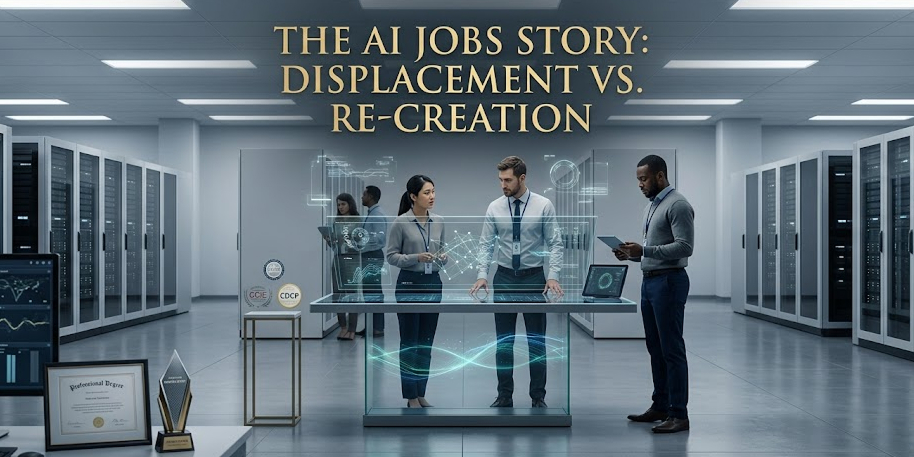
The AI jobs story is messier — and more interesting — than the headlines suggest.
Depending on which headline you clicked last week, AI is either the greatest job-creation engine in a generation or the beginning of a white-collar extinction event. The truth, as of May 2026, is more complicated than either — and understanding the nuance could matter a lot for your own career and your portfolio.
Here's what the data actually shows right now.
📉 The Job Losses Are Real. But They're Concentrated.
Goldman Sachs Research published an estimate in April 2026 that AI is erasing roughly 16,000 net jobs per month in the United States — about 25,000 positions eliminated by AI substitution, offset by around 9,000 new roles created in its wake. That's a net monthly loss. It's real. But it's also playing out very unevenly across the workforce.
The hardest-hit categories so far: administrative roles, entry-level knowledge work, and junior tech positions. CBS News reported this week that AI accounted for 26% of all corporate job cuts in April — making it the second-largest single cause of layoffs in the country, behind only company closures. In past automation cycles, factory floors bore the brunt. This time, the disruption is landing in office buildings.
The most striking data point isn't layoffs — it's the hiring slowdown for young workers. A Federal Reserve Bank of New York study found that recent college graduates aged 22 to 27 face an unemployment rate of 5.6%, compared to 4.3% for the broader workforce. Companies that used to hire cohorts of junior analysts, paralegals, and entry-level coders to do structured cognitive work are doing more of it with AI — and fewer entry points mean a narrowing ladder for the next generation.
As Goldman Sachs economist Joseph Briggs put it plainly: "The big story in 2026 in labor will be AI. If we see some job losses pulled forward, that sets the stage for potential underperformance relative to our forecast."
⚠️ But Don't Panic-Read the Headlines
Before you spiral, here's the important counterweight: the macro numbers aren't reflecting a collapse — yet.
The Yale Budget Lab, which has been tracking AI's labor market footprint month by month, released its latest analysis in April and found "no substantial acceleration in the rate of change in the composition of the labor market" since generative AI went mainstream. Their co-founder Martha Gimbel has called AI's disruption "minimal" and "incredibly concentrated" so far, adding that "the rest of the economy often moves more slowly than Silicon Valley."
J.P. Morgan Private Bank offered perhaps the sharpest diagnostic: "So far, the evidence suggests that task disruption is much more widespread than job disruption. That provides a positive signal for productivity." Their logic: if AI were already capable of fully replacing knowledge workers at scale, the market incentive to do so would have already produced mass displacement. That we haven't seen it suggests the technology, while formidable, still has real limits.
Harvard Business Review put it more simply in a March 2026 analysis: AI is not replacing workers at the pace feared. It is replacing tasks.
The workers adapting to that distinction are thriving. The ones who aren't are getting squeezed out — quietly, without a dramatic announcement.
🔨 The Jobs Nobody's Talking About: Specialized Trades Are Booming
Here's the part of the AI jobs story that almost never makes the front page: the physical infrastructure required to run artificial intelligence is generating one of the biggest technical hiring booms in decades — and it pays extraordinarily well, with a catch.
AI runs on data centers. Data centers need to be built, cooled, powered, and maintained by humans — and right now there aren't nearly enough of the right ones. Between 2022 and 2026, demand for robotic technicians grew 107%, cooling system engineers by 67%, and industrial automation technicians by 51%, according to a global analysis of 50 million job postings by Randstad, the world's largest recruitment firm.
The critical word is "specialized." This isn't a boom for general construction workers who can pivot overnight. Modern AI data centers run server racks at power densities approaching 100 kilowatts per rack, require liquid-to-chip cooling systems that didn't exist at commercial scale five years ago, and need engineers who understand high-voltage direct current distribution alongside traditional facility management. Pure Data Centres and Oracle aren't just hiring HVAC technicians — they're hiring people who hold certifications like the CDCP (Certified Data Centre Professional) and have hands-on experience with advanced thermal management. That's a much narrower pipeline than the broad "trades" framing implies.
Sander van't Noordende, Randstad's CEO, told CNBC: "Ultimately, the real constraint on global tech growth isn't solely related to a shortage of microchips, energy, or capital — it is the severe scarcity of the specialized talent required to build it." Advertised wages for qualified cooling engineers have risen 10% to 15% in four years, and six-figure salaries are now standard for those who clear the bar.
The Stargate Project — the $500 billion AI infrastructure initiative between OpenAI, Oracle, and SoftBank — is projected to generate more than 100,000 U.S. jobs across construction, operations, and supporting industries. Oracle alone expects to hire nearly 8,000 people across Michigan, New Mexico, Texas, and Wisconsin to operate its new data centers. Gary Wojtaszek, executive chairman of Pure Data Centres, summed it up: "The good thing is AI won't replace any of those jobs — someone needs to man those machines." An estimated 340,000 data center positions could go unfilled by end of 2026 — not because the work doesn't exist, but because so few people yet have the credentials to do it.
💼 The White-Collar Winners: The $170,000 Jobs the Headline Promised
The infrastructure boom is the physical layer of AI job creation. But there's a parallel story on the knowledge worker side — and it's just as real, just as narrow, and just as poorly understood.
AI engineers in the U.S. now earn an average of $170,750, a 17.7% premium over non-AI peers in equivalent roles, according to labor market data compiled by Second Talent. Machine learning engineers average $186,067. The specific titles commanding the highest premiums right now are ones that barely appeared in job postings two years ago: AI Agent Architects — who design multi-agent systems where autonomous AI workers coordinate across business functions — are among the fastest-growing and highest-compensated roles in enterprise tech. Gartner projects that 40% of enterprise applications will embed task-specific AI agents by end of 2026, up from less than 5% in 2024, creating intense demand for people who can build and govern those systems. AI governance specialists, integration architects, and prompt engineers with domain expertise in legal, finance, or healthcare are pulling similarly elevated compensation.
The supply is nowhere near the demand. In January 2026 alone, 275,000 U.S. job postings required AI skills. Demand for AI governance skills is up 150% year-over-year. Demand for AI ethics expertise is up 125%. The companies that can find this talent are paying for it — and the companies that can't are increasingly building internal academies to grow it themselves.
The common thread between the infrastructure specialist and the AI agent architect: neither role is a gentle career pivot. Both require deep, verifiable, hard-to-fake expertise. The AI jobs market in 2026 isn't rewarding people for knowing about AI. It's rewarding people who can demonstrably build with it.
💡 Investor Signal: What This Means for Your Portfolio
The AI labor story has two direct investment angles that aren't obvious from the headlines.
The first is on the displacement side. Companies reporting the sharpest margins in 2026 are often doing so by running leaner on white-collar headcount — fewer junior hires, more AI-assisted output per employee. That's a genuine earnings tailwind for the near term, but it also carries a longer-term consumer spending risk: if the workers being displaced are concentrated among younger, higher-educated earners, discretionary spending in urban markets could soften in ways that lag indicators won't catch until 2027.
The second is on the creation side. The data center infrastructure buildout — electricians, HVAC engineers, controls technicians, power systems specialists — is a multi-year secular trend with genuine labor scarcity behind it. Companies positioned in that supply chain, from construction to cooling to power management, are operating in a seller's market for talent and a buyer's market for contracts.
The AI revolution is writing two very different job stories at the same time. The one getting all the headlines involves the workers being replaced. The more interesting one, for investors at least, involves the ones being hired to build the machines doing the replacing.
Sources
- CBS News — "AI emerges as a top cause of layoffs, accounting for 26% of April's job cuts" (May 8, 2026): https://www.cbsnews.com/news/ai-layoffs-job-cuts-challenger-report-april-2026/
- Goldman Sachs — "How Will AI Affect the US Labor Market?" (March 2026): https://www.goldmansachs.com/insights/articles/how-will-ai-affect-the-us-labor-market
- Yale Budget Lab — "Tracking the Impact of AI on the Labor Market" (April 2026): https://budgetlab.yale.edu/research/tracking-impact-ai-labor-market
- J.P. Morgan Private Bank — "Job destroyer? Here's what you need to know about AI and labor markets" (April 2026): https://privatebank.jpmorgan.com/nam/en/insights/markets-and-investing/ideas-and-insights/job-destroyer-heres-what-you-need-to-know-about-ai-and-labor-markets
- Yale Insights — "The Real Job Destruction from AI Is Hitting Before Careers Can Start" (May 2026): https://insights.som.yale.edu/insights/the-real-job-destruction-from-ai-is-hitting-before-careers-can-start
- CNBC — "How the red-hot AI data center boom is igniting demand for a new, lucrative career path: Trade workers" (March 18, 2026): https://www.cnbc.com/2026/03/18/ai-data-center-buildout-jobs-salary-skilled-traders-worker-shortage.html
- Second Talent — "AI Impact on the Job Market in 2026: What the Data Shows" (May 2026): https://www.secondtalent.com/resources/ai-impact-job-market-2026/
Market Munchies and Mode Mobile communications are for informational purposes only, and are not a recommendation, solicitation, or research report relating to any investment strategy, security, or digital asset. All investments involve risk including the loss of principal and past performance does not guarantee future results.
Any information contained in this commentary does not purport to be a complete description of the securities, markets, or developments referred to in this material. The information has been obtained from sources considered to be reliable, but we do not guarantee that the foregoing material is accurate or complete. There is no guarantee that any statements or opinions provided herein will prove to be correct.