
April Fools, Inc.: Why Some Corporate Pranks Work and Others Blow Up
Today is the only day of the year when a company can publish fake news on purpose and hope everyone calls it clever. Sometimes that works. Sometimes it gets awkward. Sometimes it gets regulatory. Volkswagen’s fake “Voltswagen” rebrand was detailed enough to move shares and…
Today is the only day of the year when a company can publish fake news on purpose and hope everyone calls it clever. Sometimes that works. Sometimes it gets awkward. Sometimes it gets regulatory.
Volkswagen’s fake “Voltswagen” rebrand was detailed enough to move shares and inspire at least one analyst note before Reuters later reported that the SEC probed the stunt. Tesla’s April Fools bankruptcy joke landed while investors were already jumpy, and Reuters later noted the stock fell 5.1% the next day. That is the real subject here. Corporate April Fools campaigns are not just jokes. They are management tells.
A good prank tells you management understands the difference between attention and credibility. A bad one tells you the opposite. The winners know how to create noise without tampering with product trust, corporate disclosures, or anything that could plausibly rattle customers, regulators, or traders. The losers usually reveal a deeper problem: they are too online, too pleased with themselves, or too detached from how their company is actually used in the real world. That matters because academic research has found advertising can attract investor attention and influence short-term stock returns, which is another way of saying attention has real value, right up until management starts mistaking it for trust.
That is what separates the good April Fools campaigns from the bad ones. The good ones keep the lie in the theater. The bad ones let it wander into the plumbing, the market, or the credibility stack. Taco Bell remains the cleanest example of how to do it right, mostly because it understood that a prank should feel outrageous and weirdly plausible at the same time.
The GOAT still rings
In 1996, Taco Bell took out full-page ads in six major newspapers claiming it had purchased the Liberty Bell to help reduce the national debt and would rename it the “Taco Liberty Bell.” People called newspapers, the National Park Service, and radio stations in a fury. The prank worked because it sounded ridiculous, but not instantly dismissible. It hit that narrow strip of American life where corporate opportunism and national symbolism briefly felt like they could collide in real life.
It also worked in the only language businesses never stop respecting: return. The Philadelphia Inquirer reported that the stunt cost about $300,000, generated an estimated $25 million in free publicity, boosted sales by more than $500,000 in the first week of April, and ended with Taco Bell donating $50,000 toward the upkeep of the Liberty Bell. That is not just a funny prank. That is a remarkably efficient media buy with a small reputational cleanup fee attached.
The deeper reason it worked is that Taco Bell never touched anything people actually rely on. It did not alter the product. It did not interfere with the customer experience. It did not manufacture a fake corporate event the market might reasonably treat as real. It created public chaos in a public square, then got out before the joke curdled into something uglier. That is still the gold standard. Fake in the details, true in the brand.
Bottom line: The best April Fools prank is not the funniest one. It is the one that understands exactly how much trust it can afford to borrow.
Duolingo understands the assignment
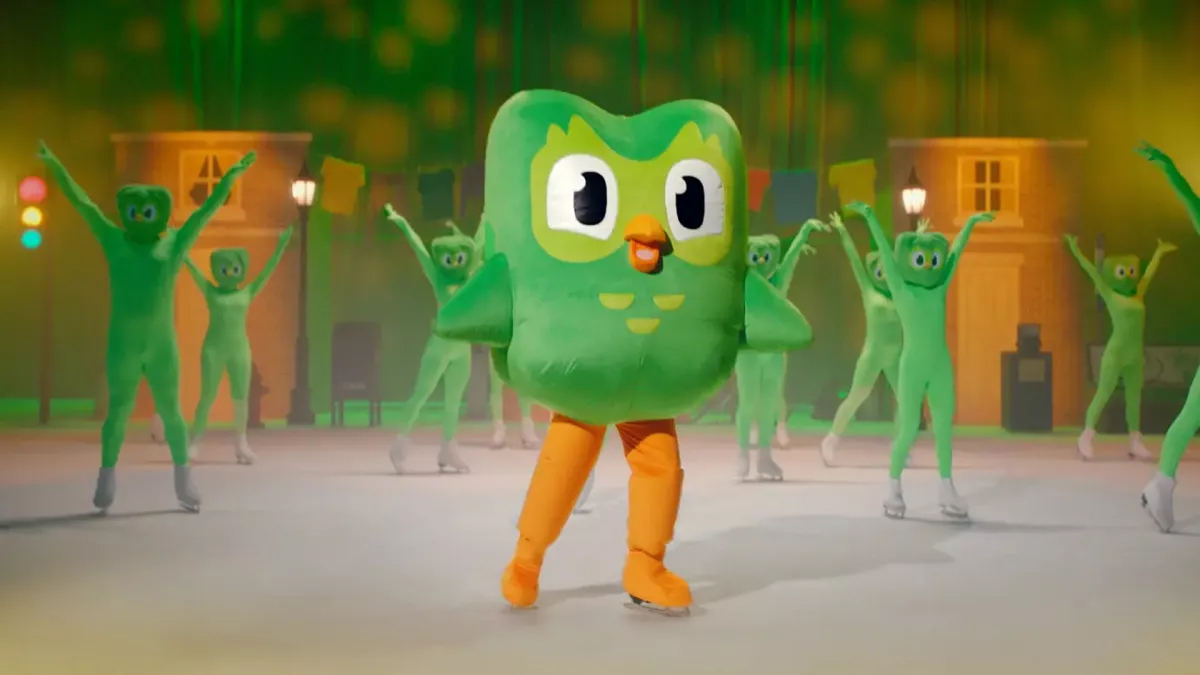
Duolingo is the modern version of this done well because it knows the joke belongs in content, not in the app’s core utility. In 2024, the company rolled out “Duolingo on Ice,” a fake live show billed as “the world’s first multilingual musical.” It teased the campaign with videos of Duo the owl trying to skate at Rockefeller Center, then unveiled the full joke on April 1 with enough production value to make the whole thing feel briefly real.
Campaign Asia reported that the campaign pulled more than 27 million TikTok views and 3.5 million likes, more than 17 million Instagram views and 1.3 million likes, plus more than 1.6 million YouTube views. That is not just a good April Fools stunt. That is a serious piece of attention engineering. More importantly, it worked because the audience already expects Duolingo to behave like this. The brand did not suddenly become weird for one day. It simply extended an existing tone people already recognize and tolerate.
This is where a lot of corporate prank attempts die. Companies assume April Fools is a humor test when it is really a permission test. Duolingo can stage a fake ice show because its audience expects a certain amount of chaos from a giant green owl that already behaves like an unlicensed performance artist online. A bank cannot do that. A brokerage should not do that. A company that handles work, money, travel, or identity has a much smaller comedy budget.
Bottom line: Content brands can get away with spectacle. Utility brands need to act like they know the difference.
The golden rule: Don’t prank the plumbing
Google’s Gmail “Mic Drop” fiasco remains the clearest example of what happens when a company forgets that rule. In 2016, Google added a “Send + Mic Drop” button that would send an email with a Minions GIF and automatically mute the thread so the sender would not see replies. On paper, someone probably thought this sounded harmlessly goofy. In practice, it shoved an April Fools joke directly into a tool people use for work, school, and serious communication.
Google later shut the feature down and admitted it should have been opt-in, should have included a confirmation step, and had been placed too close to the normal send controls. The company also said there was a bug that could cause the prank effect even when users clicked the regular send button in some cases. That is not an edgy joke. That is a workflow defect wearing a party hat.
The lesson here is bigger than Gmail. If your product is a utility, a prank cannot live inside the mechanism itself. The moment the joke changes a workflow, hides replies, adds friction, or makes the user look foolish in a real-world context, it stops being marketing and starts becoming evidence that somebody in charge confused product trust with engagement bait. That is why “don’t prank the plumbing” is still the cleanest rule any executive could write on a whiteboard on March 31.
Bottom line: If the joke adds a click, changes a workflow, or touches the product’s core function, it is not a joke anymore.
Wall Street has no joke setting
This gets much riskier once the company is public, because markets do not switch into irony mode just because the calendar says April 1. Tesla’s prank in 2018 was a fake bankruptcy announcement. Elon Musk posted that despite “intense efforts to raise money,” including a last-ditch sale of Easter eggs, Tesla had gone “completely and totally bankrupt.” Reuters later noted the stock fell 5.1% the following day. That was not because investors are humorless. It was because joking about bankruptcy while people are already worried about financing and execution is a very specific kind of unforced error.
Volkswagen’s “Voltswagen” stunt was even more revealing because it blurred the line between prank and corporate communication. The company’s U.S. unit falsely said it was changing its name to “Voltswagen” to emphasize its electric push, complete with posted materials and a detailed description of the supposed rebrand. Reuters reported that the fake announcement was picked up globally, at least one analyst praised it in a research note, and Volkswagen’s preferred shares, common shares, and ADRs rose on the day of the phony news. Reuters later reported that the SEC opened an inquiry into the stunt. That should have ended the conversation for every public-company comms team in America.
This is why a CEO’s April Fools instinct can function as a volatility indicator. It tells you whether leadership understands timing, context, and the difference between being culturally fluent and being cavalier with credibility. Investors do not just own the product. They also own management judgment. On April 1, that judgment sometimes walks onstage in clown shoes and introduces itself.
Bottom line: Public companies can joke about a lot of things. They should not joke about bankruptcy, rebrands, or anything the market might reasonably mistake for news.
Why 2026 makes this harder, not easier
The old April Fools formula was simple: make something fake look real just long enough to spread. In 2026, that is a more dangerous game because the internet is already packed with plausible falsehoods. A useful recent example is the fake post on the SEC’s X account in January 2024 claiming the agency had approved spot bitcoin ETFs. Reuters reported that bitcoin jumped to around $48,000 on the fake post, then fell back below $45,000 after the SEC deleted and disavowed it. That was not an April Fools prank, but it was a very clean demonstration of how fast a believable fake can move money now.
Reuters also reported in 2025 that a British study found AI-generated fake news raises the risk of bank runs, with researchers warning that generative AI makes it easier to create false stories or even joke-like memes about a bank’s safety and push them across social media. The same Reuters report noted that the Financial Stability Board had warned generative AI could help spread disinformation that triggers flash crashes and bank runs. That does not prove one brand’s April Fools post will tank a stock in seconds, but it does make the broader point painfully obvious: “plausible” is no longer just a creative ambition. It is a market hazard.
That is the brutally honest update to this tradition. Twenty years ago, a good prank sat on the line between absurd and believable. In 2026, that line is crowded with hacked accounts, AI-generated sludge, fake screenshots, cloned voices, and trading systems that react before humans have finished deciding whether something is a joke. The risk is no longer just that someone might not get it. The risk is that the market might.
Bottom line: In the deepfake era, “just believable enough” is not always clever. Sometimes it is reckless.
The real tell
That is why the smartest question on April 1 is not “was it funny?” It is “what did this reveal?” Taco Bell revealed a brand that knew exactly how much trust it could borrow. Duolingo revealed a company that understands the difference between content and utility. Google revealed what happens when a company gets too pleased with its own cleverness and starts tampering with the plumbing. Tesla and Volkswagen revealed the costlier version of the same mistake: once leadership starts treating credibility like a prop, the audience is not the only thing that can turn on them.
That is the real value of corporate April Fools. It is not a creativity contest so much as a judgment audit with better engagement metrics. A prank can show whether a company understands tone, timing, boundaries, and the difference between attention that spikes and trust that compounds. Every year, brands try to prove they are in on the joke. The ones that matter prove they know where the joke ends. The ones that do not usually learn the same lesson the hard way: laughs are cheap, credibility is not, and the market has terrible taste in punchlines.
Sources
- https://www.reuters.com/business/autos-transportation/us-sec-probes-vw-voltswagen-marketing-stunt-source-2021-04-29/
- https://www.reuters.com/business/youll-be-glad-you-bought-flamethrower-tweets-elon-musk-2022-08-17/
- https://blog.google/products-and-platforms/products/gmail/introducing-gmail-mic-drop/
- https://www.inquirer.com/history/taco-bell-april-fools-day-prank-20250331.html
- https://www.inquirer.com/philly/living/20140330_April_already__Surely__you_jest.html
- https://www.inquirer.com/food/liberty-bell-taco-buy-april-fools-20210325.html
- https://www.campaignasia.com/article/duolingo-on-ice-was-just-an-april-fools-joke-but-heres-how-the-brand-made-it/hjqg6bcjst6mfljt0oh07p82ap
- https://academic.oup.com/rfs/article/27/6/1797/1596985
- https://www.reuters.com/technology/us-sec-has-not-approved-bitcoin-etfs-social-media-account-compromised-2024-01-09/
- https://www.reuters.com/technology/cybersecurity/us-sec-fbi-join-probe-into-watchdogs-fake-x-social-media-post-2024-01-10/
- https://www.reuters.com/technology/artificial-intelligence/ai-generated-content-raises-risks-more-bank-runs-uk-study-shows-2025-02-14/
Market Munchies and Mode Mobile communications are for informational purposes only, and are not a recommendation, solicitation, or research report relating to any investment strategy, security, or digital asset. All investments involve risk including the loss of principal and past performance does not guarantee future results.
Any information contained in this commentary does not purport to be a complete description of the securities, markets, or developments referred to in this material. The information has been obtained from sources considered to be reliable, but we do not guarantee that the foregoing material is accurate or complete. There is no guarantee that any statements or opinions provided herein will prove to be correct.