
Big Banks vs. Stablecoins: Why Brian Armstrong Says Washington Is Playing Favorites
🏦 Armstrong Fires Back at the Banking Lobby Coinbase CEO Brian Armstrong didn't mince words. In a public statement that rippled across the crypto industry, Armstrong accused major U.S. banks of trying to undermine the president's crypto agenda by pushing legislative language…
🏦 Armstrong Fires Back at the Banking Lobby
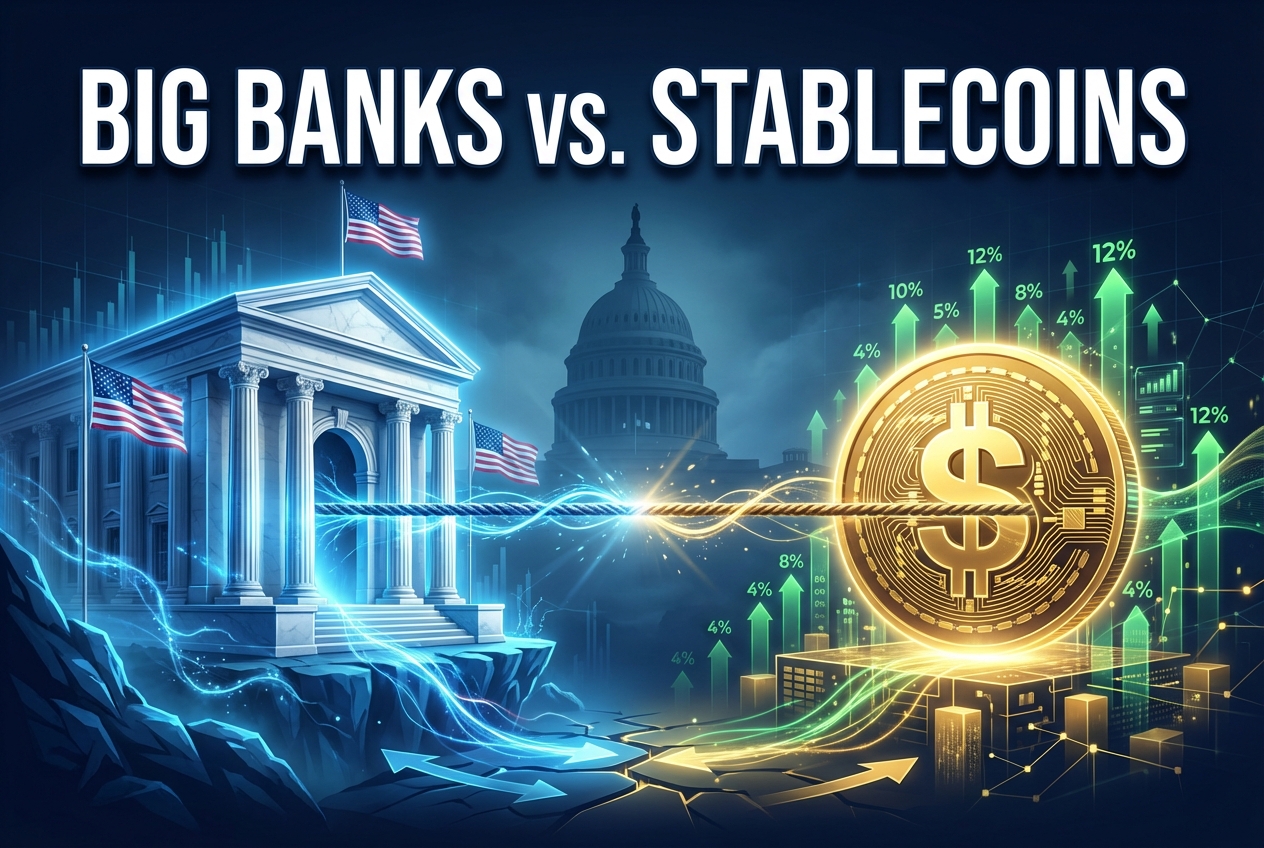
Coinbase CEO Brian Armstrong didn't mince words. In a public statement that rippled across the crypto industry, Armstrong accused major U.S. banks of trying to undermine the president's crypto agenda by pushing legislative language that would ban yield on stablecoins. The target of Armstrong's criticism is the CLARITY Act, a sweeping crypto market structure bill working its way through Congress. Buried in the latest draft is language that would prohibit stablecoin issuers from paying yield "directly, indirectly, and through anything economically or functionally equivalent to bank interest." For Armstrong, that phrasing is a tell. It's not neutral regulatory language, he argued. It's a carve-out written to protect bank deposit accounts from competition. Coinbase formally stated it "cannot support" the current text, and Armstrong called the provision a "giveaway to the banks."
💵 What's Actually at Stake for Stablecoin Holders
The fight isn't abstract. Right now, platforms like Coinbase pass along 4 to 5 percent Treasury returns to users who hold stablecoins such as USDC. For everyday holders, that's a meaningful yield in an era when many savings accounts still pay a fraction of a percent. In 2025, stablecoin volume hit an estimated $33 trillion in transactions, with USDC alone accounting for roughly $18.3 trillion of that flow. Coinbase generated approximately $1.35 billion in stablecoin revenue in 2025, representing nearly 19 percent of the company's total revenue. If the CLARITY Act's current yield ban passes, those earnings shrink, and the competitive edge that stablecoins hold over traditional bank accounts disappears almost overnight. Retail investors who've grown accustomed to earning yield on their digital dollar holdings would be the first to feel the impact.
🏛️ The Legislative Battleground: CLARITY Act vs. GENIUS Act
Understanding this dispute requires a quick look at the legislative landscape. The GENIUS Act, which became the first major U.S. law governing stablecoins, laid foundational rules but left market structure questions unresolved. The CLARITY Act was designed as the follow-up, addressing broader crypto regulation including yield on stablecoins. Senators Thom Tillis and Angela Alsobrooks proposed compromise language that bans passive yield earned simply for holding a stablecoin, while allowing activity-based rewards tied to payments or transfers. The crypto industry views even this compromise with skepticism, noting that the distinction between "passive" and "active" yield is legally murky and could be used to chill most stablecoin yield products in practice. The Senate Banking Committee has been the key battleground, with the bill stalled repeatedly over these exact provisions.
🏢 Why Banks Are Pushing So Hard
Follow the money. Standard Chartered analysts estimated that a stablecoin yield provision, if enacted, could redirect up to $500 billion in bank deposits toward crypto products by 2028. A separate Treasury-linked study cited by JPMorgan CEO Jamie Dimon and Bank of America executives put that figure even higher, warning of up to $6.6 trillion in deposit outflows if stablecoins were allowed to offer yield. Dimon argued that any stablecoin issuer paying interest should be regulated as a bank, a framing that conveniently raises the compliance cost bar for crypto firms. The irony is that JPMorgan and Citigroup have both been quietly investing in blockchain-based settlement systems and tokenized deposit rails, meaning banks want to limit competition today while positioning themselves to offer similar products tomorrow. The lobbying push, critics say, is less about protecting consumers and more about protecting margins.
📉 Market Reaction: Circle Takes the Hit
Financial markets have already delivered a verdict of sorts. When the latest restrictive yield language surfaced in the CLARITY Act, Circle, the issuer of USDC, saw its stock fall 20 percent in a single session, wiping out $5.6 billion in market value in one day. Broader crypto stocks declined more than 10 percent on the news, according to market reports. That kind of reaction reflects how central stablecoin yield has become to the business models of crypto-native firms. For investors holding positions in Coinbase, Circle, or stablecoin-adjacent assets, the legislative outcome of the CLARITY Act is now a direct earnings variable. The stakes are no longer theoretical. The industry is pricing in real regulatory risk with every new draft that comes out of Washington.
🎯 What This Means for the Future of Digital Money
President Trump publicly weighed in on Truth Social, accusing banks of "threatening and undermining" the GENIUS Act and writing that "Americans should earn money on their money." That kind of presidential attention adds political pressure but doesn't guarantee a legislative outcome. The stablecoin market currently sits at $316 billion and is projected by Citigroup research to grow to between $500 billion and $3.7 trillion by 2030. The policy decisions made in this legislative cycle will determine whether that growth benefits consumers through yield, or flows primarily back to traditional financial institutions. For traders and long-term investors, Armstrong's public confrontation with the banking lobby signals that crypto's biggest players are no longer staying quiet when incumbents seek to write rules in their favor. The outcome of the CLARITY Act will set a precedent for how much of the financial system's next chapter gets built on open rails versus protected ones.
Sources
https://crypto.news/coinbases-armstrong-says-big-banks-are-trying-to-choke-off-stablecoin-yields/ https://www.coindesk.com/policy/2026/03/23/stablecoin-yield-in-crypto-clarity-act-won-t-allow-rewards-on-balances-latest-text-says https://www.disruptionbanking.com/2026/03/22/clarity-act-unblocked-stablecoin-yield-compromise-reached/ https://www.cnbc.com/2026/03/04/trump-crypto-banks-stablecoin-yield.html https://www.coinreporter.io/2026/03/crypto-stocks-decline-over-10-on-looming-stablecoin-yield-ban/
Market Munchies and Mode Mobile communications are for informational purposes only, and are not a recommendation, solicitation, or research report relating to any investment strategy, security, or digital asset. All investments involve risk including the loss of principal and past performance does not guarantee future results.
Any information contained in this commentary does not purport to be a complete description of the securities, markets, or developments referred to in this material. The information has been obtained from sources considered to be reliable, but we do not guarantee that the foregoing material is accurate or complete. There is no guarantee that any statements or opinions provided herein will prove to be correct.
Get fresh insights, breaking news, and hidden gems in the world of crypto—delivered straight to your inbox with our Crypto Cookies newsletter. Don't miss out—sign up now and get your first bite of insider knowledge! Alternative Headlines 1. The CLARITY Act's Hidden Clause: How Big Banks Are Fighting to Block Your Stablecoin Yield 2. Coinbase's Brian Armstrong Calls Out Washington's Bank-Friendly Stablecoin Rules Call to Actions 1. Big banks are lobbying to kill your stablecoin yield. Read why this fight in Washington could change how you earn on digital dollars. 2. The CLARITY Act could wipe out stablecoin yields overnight. Here's what every crypto holder needs to know before Congress votes. Teaser Paragraph Coinbase CEO Brian Armstrong is taking the gloves off, publicly accusing major U.S. banks of lobbying to kill stablecoin yields before they can threaten traditional deposit accounts. At the center of the fight is the CLARITY Act, which includes language that would ban platforms from passing Treasury returns to stablecoin holders. With $33 trillion in stablecoin volume on the line and Circle's stock already down 20 percent on the news, the stakes couldn't be higher. Here's who's fighting, why it matters, and what it means for your portfolio. stablecoin yield, CLARITY Act, GENIUS Act, Coinbase, Brian Armstrong, Circle, USDC, crypto regulation, banking lobby, stablecoin legislation, JPMorgan, Trump crypto, digital dollar, crypto investing, stablecoin interest