
CFTC Takes Illinois to Court as Prediction Market Turf War Heats Up
⚖️ Federal Government Sues Illinois Over Prediction Market Crackdown The Commodity Futures Trading Commission and the Department of Justice filed a federal lawsuit on April 2, 2026, targeting Illinois directly over its efforts to shut down prediction market operators in the…
⚖️ Federal Government Sues Illinois Over Prediction Market Crackdown
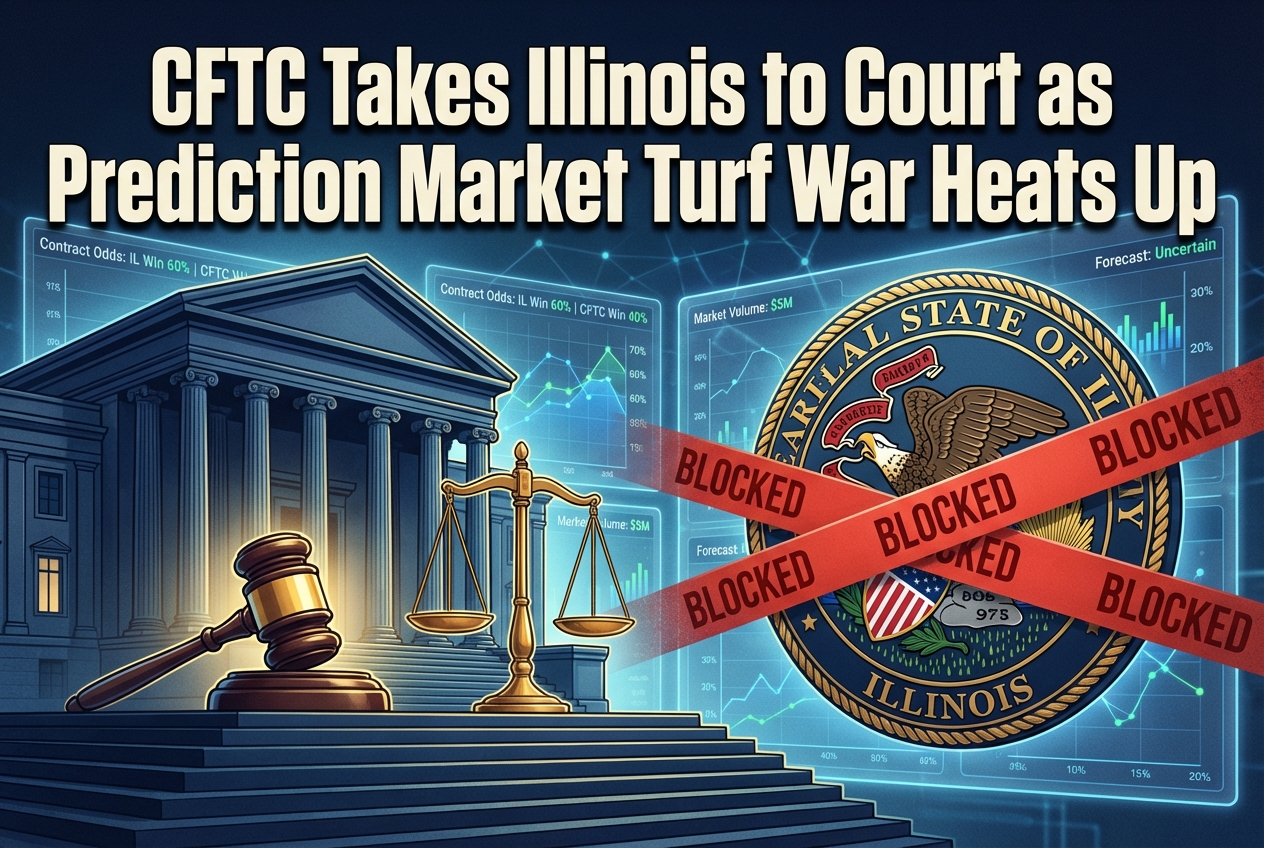
The Commodity Futures Trading Commission and the Department of Justice filed a federal lawsuit on April 2, 2026, targeting Illinois directly over its efforts to shut down prediction market operators in the state. The complaint names Governor J.B. Pritzker, Attorney General Kwame Raoul, and five Illinois Gaming Board officials as defendants. The federal government is asking a court to permanently block Illinois from applying state gambling laws to platforms already licensed by the CFTC as Designated Contract Markets (DCMs). This is one of the most aggressive moves yet in a growing fight between federal regulators and state gaming authorities over who actually controls this fast-growing sector. For traders and investors with exposure to prediction market platforms, the outcome could determine whether these products remain accessible across the country or get carved up by a patchwork of conflicting state rules.
🎲 Prediction Markets 101: What Is Actually Being Fought Over
Prediction markets are platforms where users buy and sell contracts tied to real-world outcomes, like election results, economic indicators, or sports scores. The price of a contract reflects the crowd's collective probability estimate for that outcome. Platforms like Kalshi and Polymarket have grown significantly in recent years, attracting retail traders who want to speculate on events outside traditional financial markets. Kalshi operates as a federally licensed DCM under the CFTC's oversight, meaning it clears trades as commodity event contracts. Illinois, like several other states, argues that these contracts are simply sports betting in a different wrapper and that state gaming licenses should be required. The CFTC and DOJ disagree, and they are now making that disagreement official in federal court.
🏛️ Illinois Says It Is Protecting Consumers, Not Overreaching
Illinois has not been passive in this dispute. The Illinois Gaming Board sent cease-and-desist letters to Kalshi, Crypto.com, and Robinhood in April 2025, and sent another to Polymarket in January 2026, accusing all four of conducting unlicensed sports wagering under state law. Governor Pritzker's office pushed back hard against the federal lawsuit, with a spokesperson stating that "The Trump Administration is carrying water for companies driving well-documented and lucrative insider trading schemes" and that these platforms are "making record profits while exposing Illinoisans to gaming products with no basic consumer protections or oversight." That framing, pairing insider trading concerns with consumer protection language, signals that Illinois intends to fight this case on both legal and political grounds. It also puts the spotlight on a real tension: federal licensing does not automatically come with the kind of consumer safeguards that state gaming regulations typically require.
📜 The Legal Core: Federal Preemption Under the Commodity Exchange Act
The CFTC's argument rests on the Commodity Exchange Act, which grants the agency broad authority over commodity derivatives including contracts tied to the "occurrence, nonoccurrence, or the extent of the occurrence" of events. Because Kalshi and similar platforms operate as DCMs under this framework, the federal government argues that state law simply cannot override federal commodity regulation in this space. Courts in Tennessee and Nevada have recently sided with this interpretation to varying degrees. In February 2026, a federal court in Tennessee granted Kalshi a preliminary injunction, finding that sports event contracts are likely swaps under the CEA and that federal preemption applies. Illinois will likely counter that gaming exclusions within the CEA, combined with the longstanding presumption against federal preemption in areas of traditional state authority like gambling, leave room for state oversight to coexist.
🗺️ Illinois Is Not Alone: Arizona and Connecticut Also Named
Illinois is not the only state in the crosshairs. The federal government filed similar lawsuits against Arizona and Connecticut on the same day, suggesting this is a coordinated strategy rather than a one-off enforcement action. The simultaneous filings point to a deliberate federal push to resolve the jurisdictional question once and for all before it fragments further. Massachusetts has also been active in this space, with a state court initially barring Kalshi from operating for in-state users, though an appeals court later stayed that injunction. For prediction market operators, the situation currently represents a compliance nightmare: platforms licensed at the federal level still face the threat of cease-and-desist letters, injunctions, and potential criminal referrals in individual states. The CFTC has also signaled that formal rulemaking on prediction markets is coming, which could further clarify the federal framework, though that process will take time.
🎯 What This Means for Traders and the Industry's Future
For traders and investors watching this space, the federal lawsuit against Illinois and two other states is a meaningful escalation that could tip the legal landscape decisively in favor of federal oversight. If the courts agree with the CFTC's preemption argument, platforms like Kalshi, Polymarket, and Robinhood's event contracts could operate nationally without fear of state-level crackdowns. That would be a significant unlock for the sector, enabling more liquidity, more participants, and cleaner regulatory footing for institutional involvement. On the other hand, if Illinois and other states prevail, prediction markets could end up operating only in states that choose to permit them, reducing market depth and raising compliance costs for every platform in the space. The coming months of litigation will be closely watched by fintech investors, platform operators, and anyone holding positions on prediction market-adjacent companies. The outcome of these lawsuits may define the boundaries of this industry for years to come.
Sources
https://www.theblock.co/post/396258/cftc-sues-illinois-gov-pritzker-escalating-fight-jurisdiction-prediction-markets https://www.hklaw.com/en/insights/publications/2026/02/prediction-markets-at-a-crossroads-the-continued-jurisdictional-battle https://www.sidley.com/en/insights/newsupdates/2026/02/us-cftc-signals-imminent-rulemaking-on-prediction-markets https://gvwire.com/2026/04/02/us-sues-arizona-connecticut-illinois-to-stop-regulation-of-prediction-markets/
Market Munchies and Mode Mobile communications are for informational purposes only, and are not a recommendation, solicitation, or research report relating to any investment strategy, security, or digital asset. All investments involve risk including the loss of principal and past performance does not guarantee future results.
Any information contained in this commentary does not purport to be a complete description of the securities, markets, or developments referred to in this material. The information has been obtained from sources considered to be reliable, but we do not guarantee that the foregoing material is accurate or complete. There is no guarantee that any statements or opinions provided herein will prove to be correct.
Get fresh insights, breaking news, and hidden gems in the world of crypto—delivered straight to your inbox with our Crypto Cookies newsletter. Don't miss out—sign up now and get your first bite of insider knowledge! KEYWORDS: CFTC, prediction markets, Illinois, Pritzker, Kalshi, Polymarket, federal preemption, Commodity Exchange Act, sports betting, crypto regulation, DOJ, event contracts, fintech, gambling laws, DCM