
Fogo Cancels $20M Token Sale, Pivots to Community Airdrop Ahead of January Launch
💥 Breaking the Mold: Fogo's $20M Decision Blockchain startup Fogo has canceled its planned $20 million token presale just weeks before its scheduled mainnet launch on January 13, 2026. The presale, which was set at a $1 billion fully diluted valuation, would have offered 2% of…
💥 Breaking the Mold: Fogo's $20M Decision
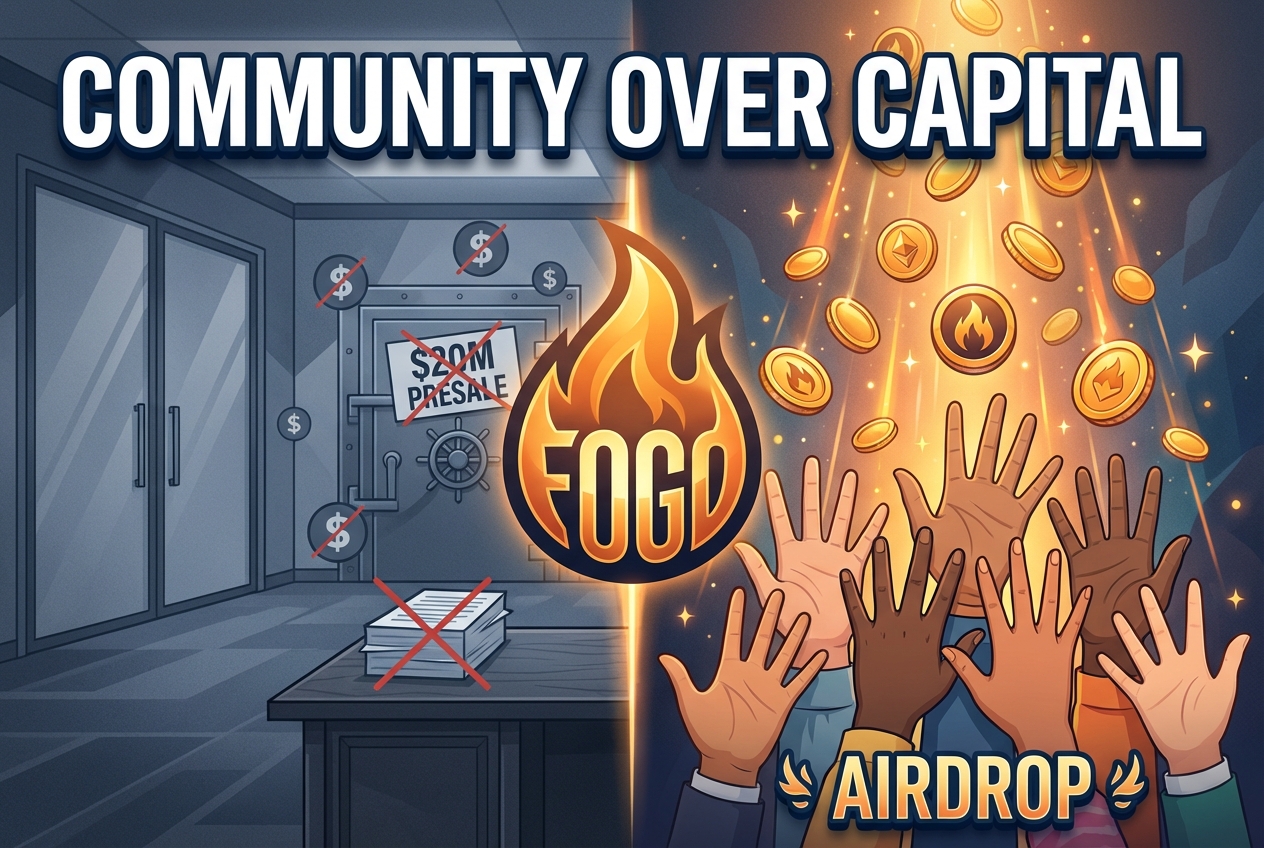
Blockchain startup Fogo has canceled its planned $20 million token presale just weeks before its scheduled mainnet launch on January 13, 2026. The presale, which was set at a $1 billion fully diluted valuation, would have offered 2% of the FOGO token's total supply to early investors. Instead, the team will now distribute that entire 2% allocation via airdrop to early users who have engaged with the network during its testnet phase. For retail investors, this represents a rare opportunity to access tokens without competing against deep-pocketed venture capital funds. The decision marks a significant departure from the traditional crypto fundraising playbook, where presales typically prioritize institutional capital over community participation. Traders watching this space should note that the move could set a precedent for how new layer 1 blockchains approach token distribution in an increasingly competitive market.
🎯 Why Community Over Capital Matters for Token Launches
The traditional crypto presale model has faced mounting criticism for concentrating token ownership in the hands of a few early investors while leaving retail participants with limited access at launch. Fogo's airdrop-first strategy flips this dynamic by rewarding users based on network engagement rather than investment capacity. According to industry analysis, this approach prioritizes sustainable growth and network resilience over short-term fundraising milestones. For investors, the implications are significant. Airdrops distribute tokens more broadly across the user base, potentially creating a more decentralized ownership structure and reducing the risk of large holders dumping tokens at launch. However, the model also carries risks, as the project foregoes immediate capital that could be used for development and marketing. The shift reflects broader tensions in the crypto industry about who should benefit most from new protocol launches and whether traditional venture capital-dominated funding structures serve long-term ecosystem health.
🔥 The Flames Points Program: How Early Users Benefit
Fogo is running a points-based reward system called Flames, which tracks user activity during the testnet phase and will convert to FOGO tokens once the mainnet goes live. Participants can earn Flames through several activities, including playing the Fishers game, using Portal Bridge to transfer assets, and bridging USDC into the network. The system is designed to incentivize on-chain participation and familiarize users with the network's capabilities before the official launch. For traders, this creates an opportunity to accumulate future token allocations through active engagement rather than capital deployment. The mechanics mirror successful airdrop campaigns from projects like Arbitrum and Optimism, which rewarded early adopters who tested network functionality. However, the conversion rate from Flames points to FOGO tokens has not been disclosed, leaving some uncertainty about the ultimate value of accumulated points. Users should approach the program with the understanding that point valuations can be highly variable and that early participation does not guarantee proportional token rewards.
⚡ Fogo's SVM Architecture: Speed and Performance Claims
Fogo is built using the Solana Virtual Machine, the same technological framework that powers the Solana blockchain, and claims to deliver 40-millisecond block times. For context, Solana itself operates with roughly 400-millisecond block times, meaning Fogo's stated performance would represent a 10x improvement if achieved at scale. The team, composed of former Wall Street executives, is targeting real-time trade execution and reduced malicious MEV, or miner extractable value, which refers to profits extracted by reordering transactions. For traders, faster block times translate to quicker trade confirmations and potentially lower latency for arbitrage and high-frequency strategies. However, claims of ultra-low latency should be evaluated cautiously, as testnet performance often differs significantly from mainnet conditions under real transaction load. The SVM architecture gives Fogo compatibility with Solana's existing developer tooling and smart contract standards, potentially lowering the barrier for developers to port applications. Whether the network can sustain its performance targets while maintaining decentralization and security remains an open question that will be answered only after launch.
🌐 SVM Ecosystem Growth: Competition and Opportunity
The Solana Virtual Machine is rapidly evolving from a Solana-exclusive technology into a multi-chain standard, with several high-profile projects launching SVM-based networks in 2025. SOON Network, which raised $22 million through an NFT sale, launched its Alpha mainnet in January 2025 and claims 50-millisecond block times while bringing SVM to Ethereum and BNB Chain. Eclipse is building another SVM implementation designed to scale Ethereum by combining Solana's performance with Ethereum's network effects. Meanwhile, projects like Sonic and Solayer are targeting throughput improvements, with Solayer's 2025 roadmap aiming for over 1 million transactions per second using Infiniband RDMA technology. For investors, this competitive landscape presents both opportunity and risk. The SVM expansion signals growing demand for high-performance blockchain infrastructure, but it also means Fogo will face established competitors with significant technical resources and community traction. Success will likely depend on differentiation, ecosystem partnerships, and the ability to attract developers and liquidity providers to a new network.
🎯 January 2026 Launch: What Traders Need to Watch
With mainnet launch scheduled for January 13, 2026, traders should monitor several key indicators to assess Fogo's viability. First, the actual conversion rate from Flames points to FOGO tokens will determine how much value early participants receive and could influence initial sell pressure. Second, network performance metrics, particularly whether Fogo can sustain its claimed 40-millisecond block times under real transaction load, will be critical for attracting high-frequency traders and DeFi protocols. Third, developer adoption and application launches in the first months will signal whether the ecosystem can gain traction beyond speculative trading. The airdrop-first model reduces some risks associated with concentrated token holdings, but it also means the project is launching without the immediate capital buffer that presales typically provide. For risk-conscious investors, waiting to see post-launch metrics rather than farming points may be the prudent approach. The broader SVM narrative is gaining momentum in 2025, but individual project success is never guaranteed, and Fogo's bold distribution strategy will be tested in a competitive market where execution ultimately matters more than innovation in tokenomics.
Sources
https://www.theblock.co/post/382435/fogo-solana-svm-airdrop-token-sale-mainnet-launch https://www.onesafe.io/blog/fogo-airdrop-first-strategy-crypto-fundraising https://coinpaprika.com/news/fogo-may-reward-early-users-as-mainnet-launch-nears/ https://medium.com/hyperlane/svm-expansion-the-landscape-beyond-solana-188757675fb6
Market Munchies and Mode Mobile communications are for informational purposes only, and are not a recommendation, solicitation, or research report relating to any investment strategy, security, or digital asset. All investments involve risk including the loss of principal and past performance does not guarantee future results.
Any information contained in this commentary does not purport to be a complete description of the securities, markets, or developments referred to in this material. The information has been obtained from sources considered to be reliable, but we do not guarantee that the foregoing material is accurate or complete. There is no guarantee that any statements or opinions provided herein will prove to be correct.
Get fresh insights, breaking news, and hidden gems in the world of crypto—delivered straight to your inbox with our Crypto Cookies newsletter. Don’t miss out—sign up now and get your first bite of insider knowledge!