
How the AI Revolution Triggered a Worldwide Semiconductor Investment Explosion
The Real AI Arms Race Isn’t Happening Inside Chatbots For years, semiconductors were viewed as one of Wall Street’s most cyclical industries. Chipmakers boomed during periods of strong demand, then suffered painful downturns when inventories piled up and prices collapsed.…
The Real AI Arms Race Isn’t Happening Inside Chatbots
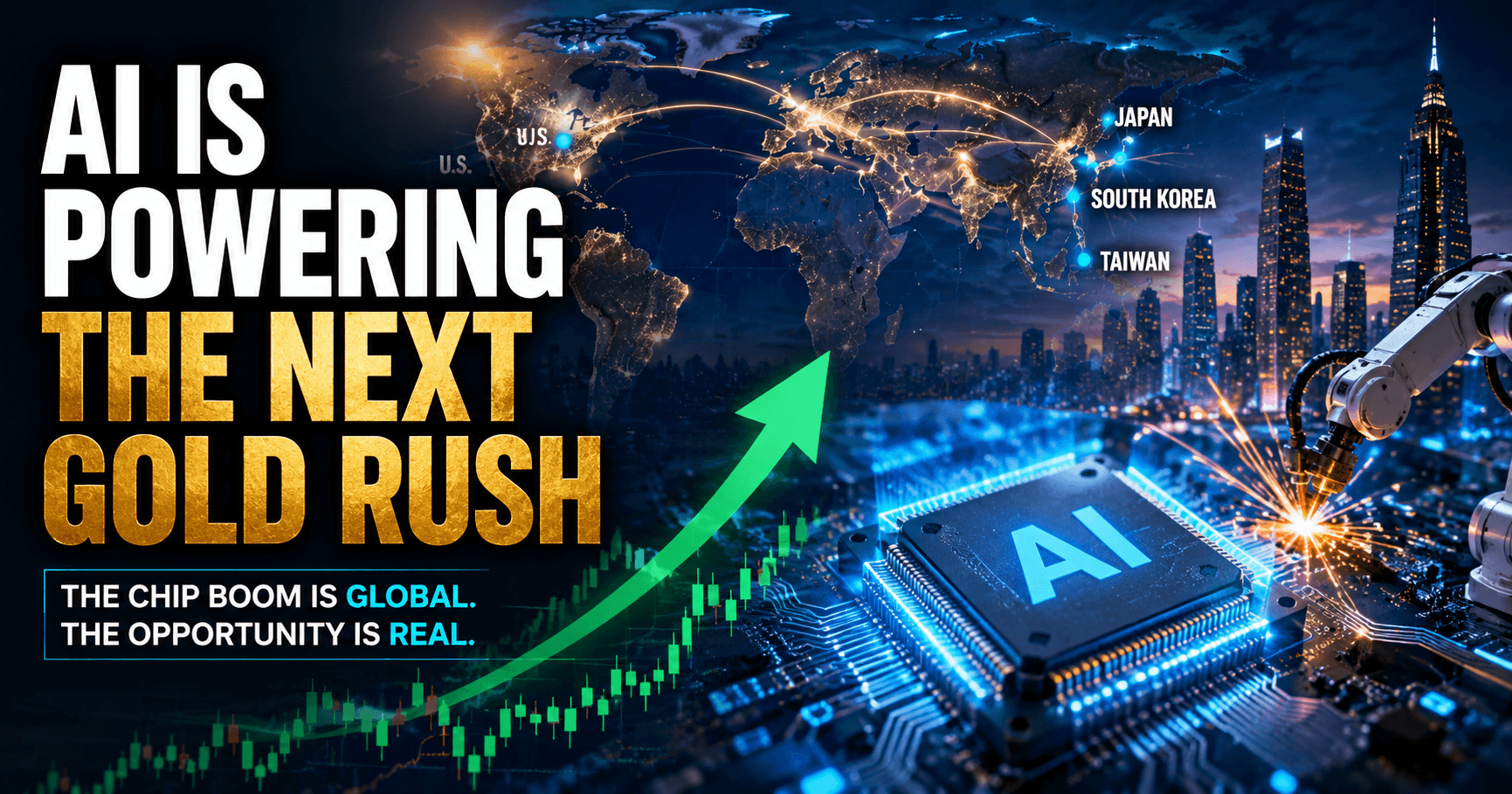
For years, semiconductors were viewed as one of Wall Street’s most cyclical industries. Chipmakers boomed during periods of strong demand, then suffered painful downturns when inventories piled up and prices collapsed. Artificial intelligence changed that narrative almost overnight. Today, semiconductors are increasingly being treated less like consumer hardware and more like critical infrastructure — comparable to power grids, railroads, or oil pipelines. Every major AI breakthrough depends on massive amounts of computing power running behind the scenes, and that computing power starts with advanced chips. That shift is transforming global markets faster than many expected. Recent rallies across Japan, South Korea, Taiwan, and the United States revealed something much larger than a temporary AI stock craze. Investors are pouring capital into the companies building the backbone of the AI economy: memory manufacturers, semiconductor foundries, AI server suppliers, and chip equipment makers. The AI revolution may dominate headlines, with chatbots and virtual assistants at the forefront. But the real financial momentum has increasingly centered on the businesses supplying the computational horsepower underneath them.
Why Semiconductor Stocks Became the Center of the AI Economy
Modern AI systems are extraordinarily resource-intensive. Training large language models requires enormous data centers packed with advanced GPUs, high-bandwidth memory, networking hardware, and sophisticated cooling systems operating continuously. Running AI at a global scale demands infrastructure that few industries have ever needed before. That has created a major shift in investment thinking: AI demand doesn’t stop at software. It extends across the entire semiconductor supply chain. Companies like Nvidia, TSMC, Samsung Electronics, and SK Hynix now sit at the center of this ecosystem because AI infrastructure depends directly on their technology. As hyperscalers and cloud providers race to expand computing capacity, demand for advanced semiconductors has accelerated at a pace rarely seen in previous chip cycles. Investors recognized the trend quickly. AI-linked semiconductor stocks surged globally as markets realized the biggest winners of the AI era may not only be software developers, but also the firms supplying the digital “picks and shovels” powering the entire industry.
Japan’s AI Resurgence Is Suddenly Serious
Japan spent decades trying to reclaim its former leadership position in global technology. Artificial intelligence may finally be giving the country a realistic path back into the spotlight. Investor enthusiasm surged after SoftBank Group rallied sharply amid renewed optimism about its AI exposure through Arm Holdings and its large-scale infrastructure investments tied to artificial intelligence. That momentum quickly spread across Japan’s broader semiconductor ecosystem:
- Tokyo Electron
- Advantest
- Renesas Electronics
- and other AI-related technology firms climbed alongside it.
Why Investors Are Paying Attention
Japan’s opportunity extends beyond chip manufacturing alone. The country has become increasingly important in semiconductor equipment, industrial robotics, advanced materials, and AI financing. Those sectors are becoming essential as global AI infrastructure spending accelerates. That distinction matters because AI growth depends on much more than consumer-facing applications. The real expansion is happening in the industrial systems supporting them. And Japan is positioning itself directly inside that infrastructure buildout.
South Korea Quietly Became One of AI’s Biggest Winners
While Nvidia captures most AI headlines, South Korea controls one of the industry’s most critical bottlenecks: memory chips. Advanced AI systems require enormous quantities of HBM (High Bandwidth Memory), a specialized form of memory essential for training and operating modern AI models efficiently. That demand has fueled powerful rallies in both SK Hynix and Samsung Electronics, as investors increasingly price in years of elevated AI infrastructure spending. Samsung surpassing the $1 trillion market valuation milestone was more than symbolic. It reflected a broader realization that advanced memory is no longer simply a commodity business. In the AI era, memory has become a strategic asset. And unlike previous semiconductor booms driven by smartphones or personal computers, demand for AI infrastructure appears far more durable. Smartphone replacement cycles eventually slow. AI computing demand continues to scale.
Taiwan Still Sits at the Center of the Entire AI System
If semiconductors are becoming the foundation of the modern digital economy, Taiwan Semiconductor Manufacturing Company (TSMC) remains one of its most important builders. Nearly every major AI company depends on TSMC’s advanced manufacturing capabilities. From Nvidia’s accelerators to AMD’s data center processors, much of today’s AI economy ultimately flows through Taiwan’s fabrication ecosystem. That dominance has created a powerful investment narrative: Owning semiconductor infrastructure increasingly means owning exposure to the broader AI economy itself.
Why TSMC’s Position Is So Important
Advanced chip manufacturing has become extraordinarily difficult, expensive, and geopolitically sensitive. Only a handful of companies worldwide can operate at the leading edge of semiconductor fabrication. Building next-generation foundries now requires tens of billions of dollars, years of engineering expertise, and highly specialized supply chains. That scarcity helps explain why investors continue rewarding semiconductor leaders despite already massive valuations. The barriers to entry are simply enormous.
The Bigger Story Investors Shouldn’t Ignore
One of the most important developments in global markets is happening quietly beneath the AI hype cycle: Capital spending is exploding. Major technology firms are committing hundreds of billions of dollars toward:
- AI data centers
- advanced networking infrastructure
- semiconductor manufacturing
- power generation and energy systems
- large-scale compute expansion
This investment wave is benefiting far more than just Silicon Valley software companies. It is creating ripple effects across:
- Korean memory manufacturers
- Japanese equipment suppliers
- Taiwanese foundries
- American cloud providers
- industrial infrastructure companies worldwide
The AI race has effectively become a global competition for computational capacity. And that competition is accelerating.
The Semiconductor Boom May Be Bigger Than Investors Think
Strategic Takeaway
Technology revolutions rarely reward only the companies that consumers notice first. During the internet boom, much of the lasting value flowed to infrastructure providers—cloud platforms, networking companies, and semiconductor firms that powered the digital economy behind the scenes. Artificial intelligence may be following the same pattern. The headlines will continue focusing on chatbots, AI assistants, and software breakthroughs. But underneath it all sits an increasingly expensive infrastructure buildout that requires advanced chips, memory systems, manufacturing capacity, and enormous amounts of energy. That is why semiconductor stocks around the world have become more than just another market trend. Investors are increasingly treating them as foundational assets in the next phase of the global economy.
Sources
- Reuters — Asia’s tech giants give AI bull run a new center of gravity
- Reuters — SK Hynix shares rally after strong AI data-center spending signals
- Taipei Times — Taiwan semiconductor market developments
- IndexBox — Samsung Electronics surpasses $1 trillion valuation amid AI chip demand
- Asia Times — Korea and Taiwan: When an AI boom lifts a nation
- CXO Digital Pulse — SoftBank surges as global AI chip rally boosts Japanese tech stocks
Market Munchies and Mode Mobile communications are for informational purposes only, and are not a recommendation, solicitation, or research report relating to any investment strategy, security, or digital asset. All investments involve risk including the loss of principal and past performance does not guarantee future results.
Any information contained in this commentary does not purport to be a complete description of the securities, markets, or developments referred to in this material. The information has been obtained from sources considered to be reliable, but we do not guarantee that the foregoing material is accurate or complete. There is no guarantee that any statements or opinions provided herein will prove to be correct.