
HypurrFi's Domain Hijack Shows DeFi's Weakest Link Isn't the Blockchain
🚨 What Happened: A Lending Protocol's Front Door Gets Kicked In On April 3, 2026, HypurrFi, a decentralized lending protocol built on Hyperliquid's HyperEVM, issued an urgent warning to its users: stay away from the hypurr.fi domain. The team had detected unauthorized changes…
🚨 What Happened: A Lending Protocol's Front Door Gets Kicked In
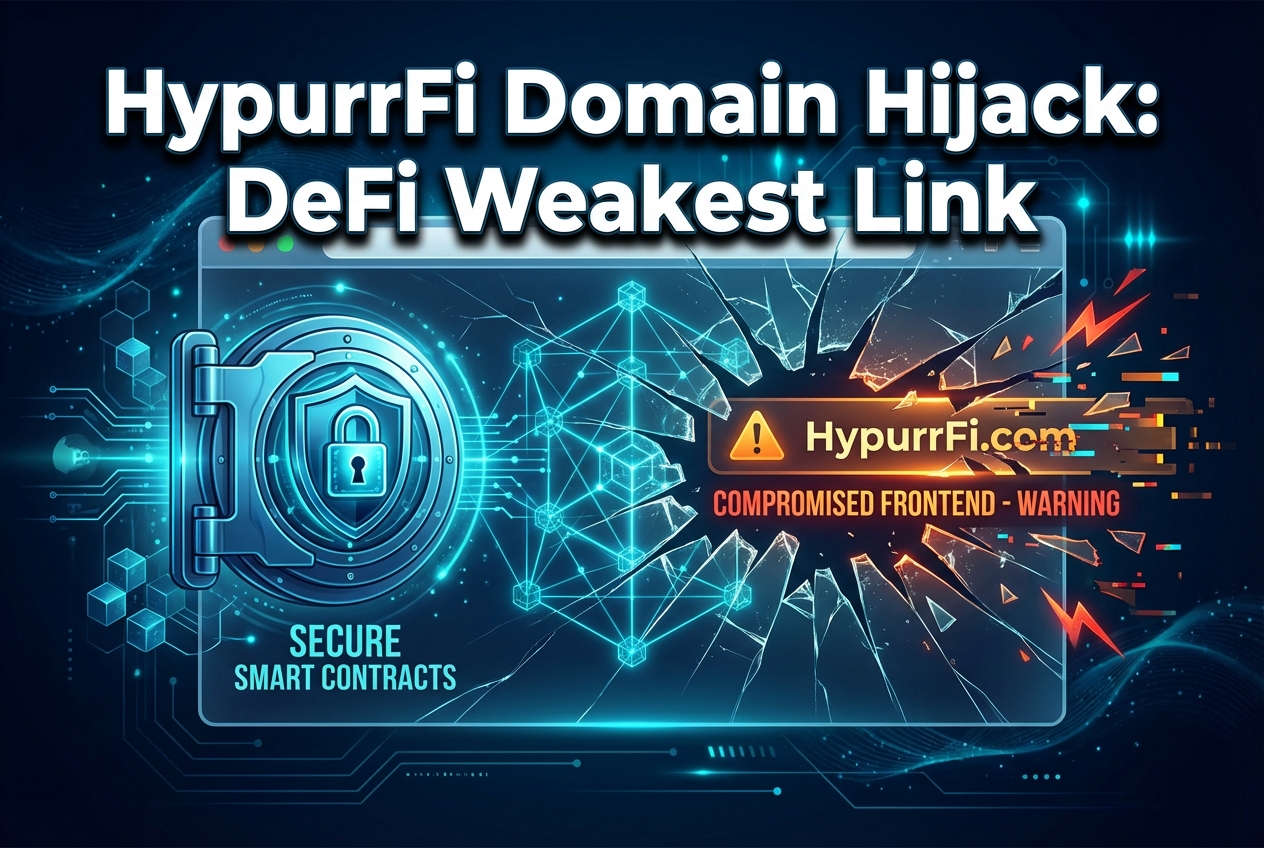
On April 3, 2026, HypurrFi, a decentralized lending protocol built on Hyperliquid's HyperEVM, issued an urgent warning to its users: stay away from the hypurr.fi domain. The team had detected unauthorized changes to their primary website, pointing to a suspected domain hijacking attack through their registrar, Openprovider. Founder Androolloyd took to X to deliver a blunt message: "DO NOT USE the Hypurr.fi domain; it is compromised." The speed and directness of that warning was notable. In previous high-profile cases, teams delayed public disclosures, giving attackers more time to drain wallets. HypurrFi's immediate transparency, while alarming to users, likely prevented a worse outcome. The incident unfolded publicly in real time, with the team simultaneously working to regain control of their DNS settings and migrate their frontend to a secure alternative domain.
🔍 How the Attack Worked: Social Engineering, Not Smart Contract Exploits
This was not a blockchain exploit. No smart contracts were touched, no private keys were stolen, and no protocol code was broken. Instead, attackers reportedly used social engineering to target HypurrFi's domain registrar, convincing support staff to hand over control of DNS settings. Once DNS records are modified, an attacker can redirect all traffic from the legitimate domain to a fraudulent lookalike site designed to drain wallets through fake approval prompts. It is a deeply effective attack because it operates entirely outside the blockchain itself. Users see what looks like the real interface, connect their wallets, and unknowingly sign malicious transactions. For DeFi protocols, this exposes a core tension: the underlying code can be perfectly audited and secure, but a single weak point in off-chain infrastructure can compromise the entire user experience. The DNS resolution layer is rarely treated with the same rigor as smart contract security.
💰 What Was at Stake: $30 Million TVL and User Trust
HypurrFi holds approximately $30 million in total value locked across its lending pools on HyperEVM. Modeled after Aave's overcollateralized supply and borrow architecture, the protocol allows users to deposit assets into liquidity pools and borrow against collateral. At the time of the incident, no user funds were reported lost, and the team confirmed that smart contracts, team systems, and official social media accounts remained fully secure. Still, the presence of $30 million in accessible deposits made this an attractive target. The protocol also moved quickly to block the compromised domain across major crypto wallets, limiting the window attackers had to exploit unsuspecting users. For investors and liquidity providers in the protocol, the outcome could have been far worse. The fact that funds remained intact is a testament to fast communication and rapid response, but the incident is a reminder of how fragile the front-facing layer of DeFi can be when the underlying registrar security is insufficient.
📈 A Growing Pattern: DeFi's Frontend Problem Isn't New
HypurrFi is far from alone in experiencing this type of attack. Frontend and DNS hijacking incidents have become one of the most consistent threat vectors in crypto over the past several years. Curve Finance suffered a registrar-level DNS hijack in May 2025. Bonk.fun's domain was hijacked in March 2026, just weeks before the HypurrFi incident. Neutrl DeFi paused its smart contracts the same month after detecting a suspected DNS frontend hijack. Going further back, MyEtherWallet lost roughly $17 million in a 2018 BGP hijacking attack. The pattern is consistent: attackers are no longer trying to break blockchain security, which has grown considerably robust. They are targeting the web2 infrastructure underneath it. Off-chain attacks accounted for more than 56% of all DeFi breaches and over 80% of stolen funds in 2024, according to security researchers, signaling that frontend vulnerabilities have become the dominant threat surface in the industry.
🛡️ What Protocols and Users Can Do Differently
The HypurrFi incident underscores a set of actionable lessons for both protocol teams and users. On the protocol side, security researchers recommend implementing DNSSEC, which cryptographically signs DNS records to prevent tampering, and enabling hardware key locks with domain registrars to prevent social engineering-based account takeovers. Continuous monitoring of DNS record changes and certificate transparency logs can also provide early warning when unauthorized modifications occur. For users, the fundamental habit shift is straightforward but not yet widely practiced: always verify URLs before connecting a wallet, avoid approving any transactions immediately after receiving an alert about an active incident, and follow official social media channels for real-time confirmation of a site's status. Protocol documentation often lists the official and alternative domains teams plan to use during outages, which can serve as a reliable fallback. Healthy skepticism toward any unexpected prompts, even on sites that look familiar, is one of the most effective defenses available to individual users.
🎯 The Bigger Picture: Security Has to Catch Up With Scale
The HypurrFi domain hijack is a case study in the uneven maturity of crypto infrastructure. The protocol's smart contracts functioned exactly as intended throughout the entire incident. Its blockchain layer held up. But the web layer, specifically the domain registration and DNS resolution systems connecting users to that blockchain layer, was the point of failure. As DeFi protocols accumulate more TVL and attract more mainstream users, the pressure on off-chain infrastructure grows proportionally. Attackers follow the money, and as smart contract auditing has matured, the attack surface has shifted upward to the application layer. For traders and investors evaluating DeFi protocols, frontend security practices should now rank alongside smart contract audits as a core due diligence item. Questions worth asking: Who controls the domain registrar account? Is DNSSEC enabled? What is the protocol's incident response plan? HypurrFi's quick response and transparent communication were the right moves, but they were reactive. The industry's next step is making robust frontend security proactive and standard.
Sources
https://www.theblock.co/post/396336/hypurrfi-investigates-domain-hijacking-warns-users-interacting-lending-protocol https://www.cryptotimes.io/2026/04/04/hypurrfi-flags-domain-hijack-urges-users-to-stay-away/ https://cryip.co/hypurrfi-domain-hijack-pushes-users-to-avoid-using-the-platform/ https://domainsure.com/articles/dns-hijacking-101-how-attackers-drain-crypto-defi-web3-platforms-without-touching-a-smart-contract/ https://www.cryptotimes.io/2026/03/19/neutrl-defi-pauses-smart-contracts-amid-suspected-dns-frontend-hijack/
Market Munchies and Mode Mobile communications are for informational purposes only, and are not a recommendation, solicitation, or research report relating to any investment strategy, security, or digital asset. All investments involve risk including the loss of principal and past performance does not guarantee future results.
Any information contained in this commentary does not purport to be a complete description of the securities, markets, or developments referred to in this material. The information has been obtained from sources considered to be reliable, but we do not guarantee that the foregoing material is accurate or complete. There is no guarantee that any statements or opinions provided herein will prove to be correct.
Get fresh insights, breaking news, and hidden gems in the world of crypto—delivered straight to your inbox with our Crypto Cookies newsletter. Don't miss out—sign up now and get your first bite of insider knowledge!