
Markets Shrug Off Iran Flare-Up as Jobs Data Steals the Show
Wall Street opened higher Friday morning as investors absorbed a surprisingly strong April jobs report and largely shrugged off a fresh exchange of fire between U.S. forces and Iran in the Strait of Hormuz. The Nasdaq led gains at the open, with the S&P 500 and Dow also…
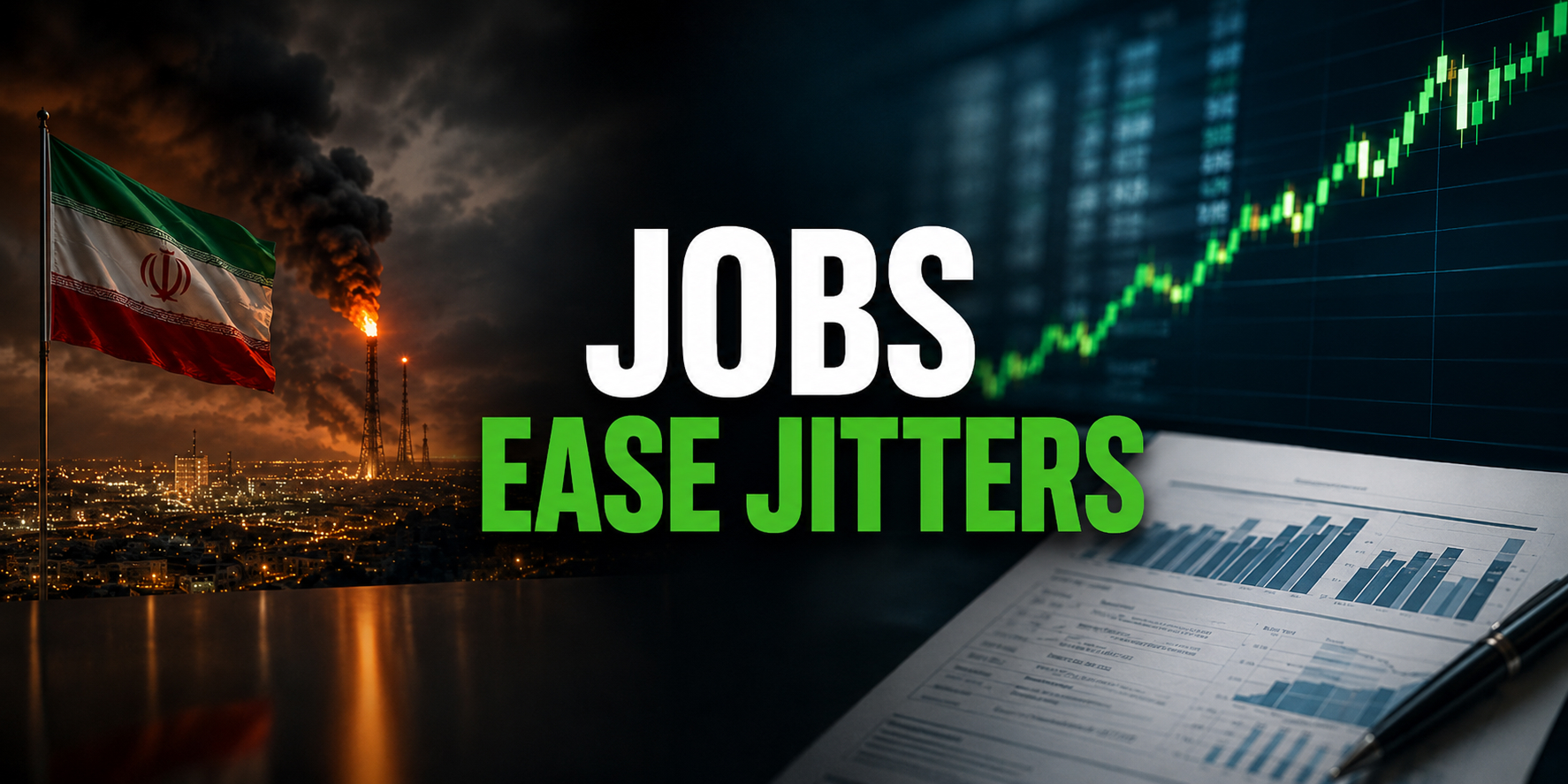
Wall Street opened higher Friday morning as investors absorbed a surprisingly strong April jobs report and largely shrugged off a fresh exchange of fire between U.S. forces and Iran in the Strait of Hormuz. The Nasdaq led gains at the open, with the S&P 500 and Dow also moving higher, and all three major averages are on track to finish the week in positive territory. The mood, at least for now, is one of cautious optimism: earnings have generally come in strong, the labor market's holding up better than feared, and geopolitical tensions haven't spiraled into the worst-case scenario markets briefly priced in last month.
The backdrop is a conflict that's been rattling energy markets since late March. After a ceasefire was announced in early April, hopes for lasting de-escalation kept bumping up against military skirmishes and stalled diplomatic talks. President Trump said the ceasefire with Iran is still in place after U.S. forces launched strikes in response to attacks on American warships, though the episode cast fresh doubt on efforts by Washington and Tehran to reach a negotiated settlement. Yet markets have once again decided to look through the noise, reflecting both a collective bet on de-escalation and a broader shift in how investors are thinking about risk right now.
The bigger story Friday may have less to do with missiles in the Persian Gulf than with a number that landed at 8:30 a.m. in Washington. Nonfarm payrolls rose by 115,000 in April, well ahead of the roughly 55,000 forecast, while the unemployment rate held at 4.3%. In a week full of high-stakes headlines, that jobs number may prove to be the most consequential data point of all.
Stock of Interest Today: Blue Owl Capital Corporation (OBDC)
Blue Owl Capital Corporation is one of the largest publicly traded business development companies (BDCs), and right now it's trading at a roughly 21% discount to its net asset value per share. For income-oriented investors, that gap is the heart of the bull case.
The company reported adjusted net investment income of $0.31 per share in Q1 2026, falling short of the $0.35 forecast, while revenue came in at $396.77 million, below expectations. The stock declined sharply in aftermarket trading following the release, reflecting investor disappointment on both lines.
Management was candid about what drove the shortfall. Three Fed rate cuts last fall are now fully reflected in results, given the lagged impact that lower rates have on a mostly floating-rate portfolio. Non-recurring income was also light, and the earnings benefit from low-cost unsecured notes issued before rates moved higher continues to roll off as those maturities come due.
NAV per share declined to $14.41 from $14.81 at year-end 2025, driven primarily by unrealized losses from credit spread widening in the broader market rather than company-specific credit deterioration, according to management. On credit quality, the picture is actually more encouraging: the quarter saw no new non-accruals, stable interest coverage ratios of 2.0x, and high-single-digit revenue and EBITDA growth across the portfolio.
The dividend is the sticking point for income investors. The board cut the quarterly base dividend by 16% to $0.31 per share for Q2, aligning it more closely with current earnings power. At $0.31, the dividend is now fully covered by adjusted NII. And with spillover income of approximately $0.28 per share remaining healthy, there's a meaningful cushion supporting the base dividend going forward.
It's a bumpy ride getting here, but a meaningful margin of safety is embedded in the current price for long-term income investors willing to wait out the macro headwinds.
Current Price: $11.34 Analyst Target: $12.50
Five Market Signals to Watch
There's a lot happening today, and any one of these stories would normally be enough to dominate the week's narrative on its own. The jobs report, a military exchange in the Strait of Hormuz, oil prices hovering above $100, and a dividend cut at one of the biggest BDCs in the country all landed within roughly 24 hours of each other.
Taken together, they tell a more nuanced story than any single headline can capture. Here are the five signals worth watching most closely.
1) The Jobs Report Lands Well Above Expectations
Nonfarm payrolls rose by 115,000 in April, down from an unusually strong prior month but well above the roughly 55,000 forecast. The unemployment rate held at 4.3%, and average hourly earnings rose just 0.2% for the month, coming in below the 0.3% estimate. Healthcare led sectoral gains, followed by transportation and retail trade.
That below-expectation wage growth is actually good news from an inflation perspective. A strong jobs number combined with cooling wages is exactly the soft-landing combination the Fed needs to stay on hold. Stock futures moved higher immediately after the 8:30 a.m. release, with one chief investment officer noting that despite headwinds like higher oil prices, sticky inflation, and higher-for-longer interest rates, the labor market is still adding jobs, GDP is growing, and corporate profits are expanding at a rapid pace.
There's an important caveat, though. It's still too early for any economic effects from the U.S.-Iranian conflict to show up in the data. The April survey period predates the most acute phase of the current tensions. The May payrolls report, due in June, will be the first real test of whether higher energy prices are starting to bite into hiring.
2) Markets Look Past Iran Strikes, Geopolitical Noise Treated as Just That
U.S. Central Command said American forces responded with self-defense strikes on Iranian targets after three Navy destroyers came under missile and drone fire, though none were hit. Washington and Tehran traded accusations over who fired first. And yet, by Friday morning, equities were higher and crude's move was modest.
The market's reaction reflects a calculus that's solidified over the past several weeks: as long as the ceasefire nominally holds and Trump signals he doesn't want full-scale escalation, individual skirmishes get treated as noise. Trump insisted the ceasefire remains in effect, calling the strikes "just a love tap," and said U.S. forces had wiped out the Iranian targets involved, including small boats and drones. That framing was enough to keep investor panic at bay.
The deeper question is whether the market's composure is wisdom or complacency. Charles Schwab strategists have outlined an adverse scenario in which limited strikes continue to impede traffic through the Strait, keeping energy prices elevated into the second half of 2026 and risking economic stagnation in Europe and Asia. The market's betting against that. Whether it's right remains very much an open question.
3) Oil Markets Signal Restraint, But Elevated Prices Are Their Own Problem
Brent crude futures added less than a dollar per barrel in Friday trading, with both Brent and WTI on track for weekly losses of more than 7%, as earlier optimism over a possible reopening of the Strait of Hormuz faded during the week. That modest Friday move confirms traders aren't pricing a full unraveling of the ceasefire, but it doesn't mean oil's out of the picture as a risk.
Crude above $100 a barrel isn't a neutral price level. It feeds directly into food prices, transportation costs, and manufacturing inputs in ways that compound over time. World food prices climbed in April to their highest level in more than three years, with vegetable oils particularly elevated due to the Iran war and effective closure of the Strait of Hormuz, driven by elevated energy costs raising demand for biofuels, according to the UN's Food and Agriculture Organization. National gasoline prices in the U.S. have already risen above $4 per gallon. These aren't abstract geopolitical variables. They're costs that households and businesses are paying right now, and they create a slow-burning headwind that Friday's jobs data hasn't fully accounted for.
4) Trump's Rhetoric Is Doing Real Market Work
It might seem odd to list a presidential turn of phrase as a market signal, but in this environment, Trump's public communications about the Iran conflict are among the most closely watched inputs for professional investors. His social media posts and off-the-cuff comments to reporters have repeatedly been the mechanism by which oil prices spike or retreat several percentage points in minutes.
This creates a genuinely unusual dynamic: the near-term trajectory of a live geopolitical conflict is being transmitted to asset prices largely through one person's messaging, and that person has shown a consistent pattern of alternating between hawkish threats and reassuring de-escalation language. Since efforts to end the war began, Trump has frequently switched between publicly projecting progress and dismissing the talks as futile, and previous efforts to reach a deal have fallen short. Markets have learned to trade the tone rather than the substance. The risk is that tone and substance eventually diverge in a way that the market isn't positioned for. For now, though, the tone is holding.
5) The Soft Landing Trade Is Being Rebuilt, One Data Point at a Time
Step back from Thursday's flare-up and Friday's relief, and what you see is a market quietly reassembling the soft-landing narrative it spent much of early 2026 dismantling. S&P 500 net profit margins hit a new record in Q1 2026, with expansion concentrated in the Information Technology sector. Real GDP grew at an annualized 2.0% in Q1, a meaningful acceleration from Q4 2025's shutdown-driven 0.5%. And now the jobs report has reinforced the picture of a labor market that's cooling without cracking.
The scenario being priced today is one where the Iran conflict de-escalates enough to let oil retreat, the Fed stays on hold, and earnings growth continues at a strong pace through the rest of 2026. That's plausible, and the data are supportive. But it's also a fragile construction. A sustained oil shock, a deterioration in the ceasefire, or a shift in Fed language toward rate hikes would each require rapid repricing. Valuations now embed an expectation that the current trajectory continues, and the market's selective reaction to big-tech capital spending plans suggests investors are no longer giving open-ended credit for AI investment without evidence of return. The market isn't priced for disruption. It's priced for resolution. That distinction is worth keeping front of mind as the news cycle keeps moving.
Bottom Line
Friday's action encapsulates the central tension of this moment: strong domestic fundamentals operating in the shadow of an unresolved geopolitical crisis. The April jobs number was genuinely good news. The Iran situation remains genuinely unresolved. The fact that markets are rising modestly rather than either surging or retreating reflects something close to the truth: the U.S. economy is more resilient than pessimists feared, and the conflict is more contained than worst-case scenarios suggested. But neither story's finished. Investors buying into this market are betting that the resolution of the geopolitical overhang will ultimately validate what the economic data is already showing. The gap between "probably fine" and "definitely fine" is where all the risk lives right now.
Sources:
- https://www.cnbc.com/2026/05/08/jobs-report-april-2026.html
- https://finance.yahoo.com/markets/stocks/live/stock-market-today-friday-may-8-iran-us-attacks-232854074.html
- https://www.thestreet.com/latest-news/stock-market-today-may-8-2026-updates
- https://www.cnbc.com/2026/05/08/oil-prices-today-wti-brent-us-iran-fire-war-hormuz-ceasefire.html
- https://www.washingtonpost.com/national-security/2026/05/07/us-strikes-iran-ceasefire/
- https://www.investing.com/news/transcripts/earnings-call-transcript-blue-owl-capital-q1-2026-results-miss-forecasts-93CH-4669763
- https://www.investing.com/news/company-news/blue-owl-capital-q1-2026-slides-earnings-miss-dividend-cut-ahead-93CH-4670325
- https://finance.yahoo.com/markets/stocks/articles/blue-owl-capital-corporation-q1-123000851.html
- https://www.chartmill.com/news/OBDC/Chartmill-47422-Blue-Owl-Capital-Corp-NYSEOBDC-Plunges-After-Q1-2026-Revenue-and-Earnings-Miss
- https://seekingalpha.com/article/4900761-blue-owl-capital-unjustified-saas-fears
- https://finance.yahoo.com/markets/commodities/articles/world-food-prices-extend-rise-081728478.html
- https://www.schwab.com/learn/story/iran-war-potential-impact-on-global-equities
- https://www.crestwoodadvisors.com/may-2026-economic-and-market-update/
- https://www.nbcnews.com/business/business-news/oil-markets-gas-prices-450-us-iran-near-deal-end-war-hormuz-rcna343819
- https://insight.factset.com/total-nonfarm-payrolls-for-april-2026-are-projected-to-rise-by-65000
- https://www.kiplinger.com/investing/economy/jobs-report-april-2026-what-to-expect
- https://www.cnbc.com/2026/05/07/stock-market-today-live-updates.html
Market Munchies and Mode Mobile communications are for informational purposes only, and are not a recommendation, solicitation, or research report relating to any investment strategy, security, or digital asset. All investments involve risk including the loss of principal and past performance does not guarantee future results.
Any information contained in this commentary does not purport to be a complete description of the securities, markets, or developments referred to in this material. The information has been obtained from sources considered to be reliable, but we do not guarantee that the foregoing material is accurate or complete. There is no guarantee that any statements or opinions provided herein will prove to be correct.