
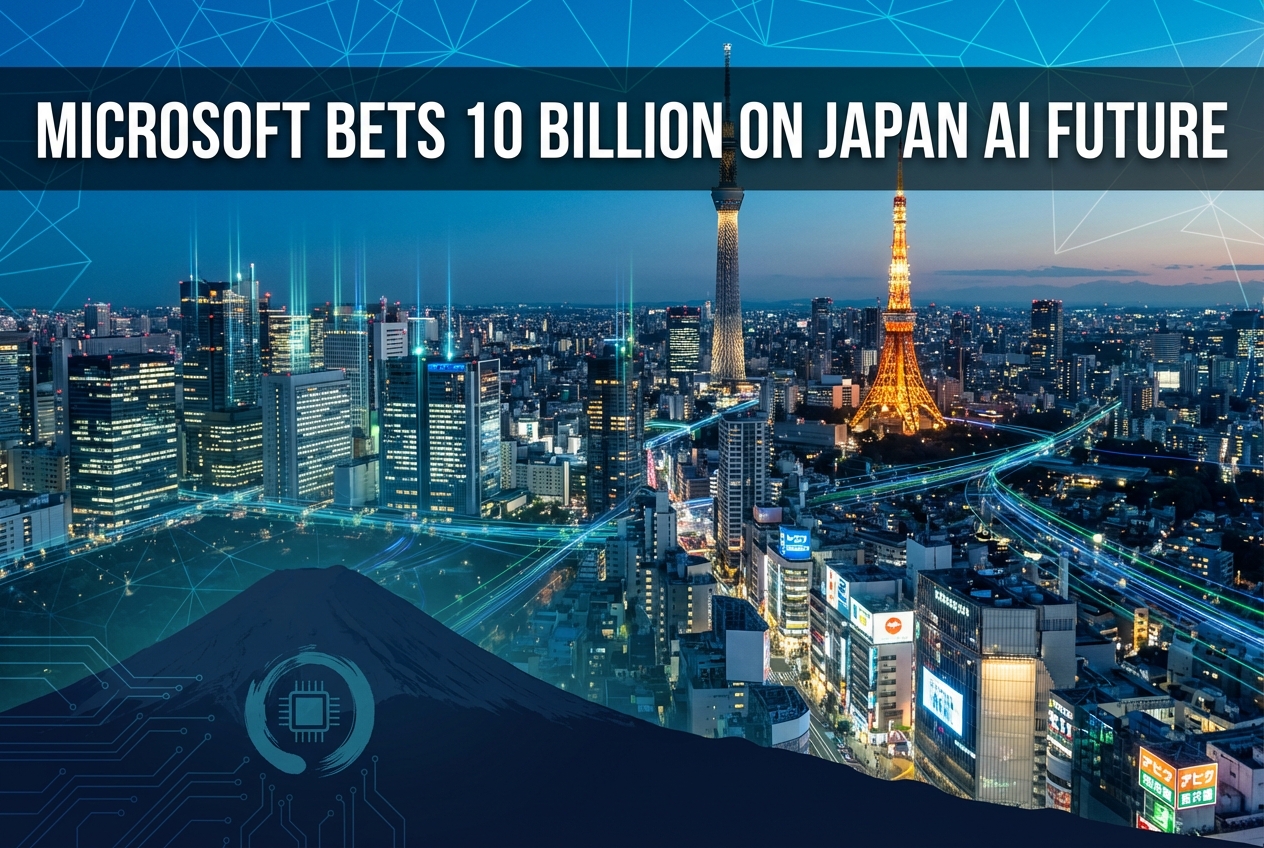
Microsoft Bets $10 Billion on Japan's AI Future
💴 A Decade-Defining Commitment Microsoft announced a $10 billion investment in Japan spanning 2026 through 2029, structured around three pillars: Technology, Trust, and Talent. The announcement was delivered in Tokyo by Microsoft President Brad Smith during a meeting with…
💴 A Decade-Defining Commitment
Microsoft announced a $10 billion investment in Japan spanning 2026 through 2029, structured around three pillars: Technology, Trust, and Talent. The announcement was delivered in Tokyo by Microsoft President Brad Smith during a meeting with Japanese Prime Minister Sanae Takaichi. Smith described the initiative as a direct response to Japan's growing demand for cloud and AI services, framing it not as a speculative bet but as a planned build-out to meet real infrastructure shortfalls. This follows a $2.9 billion commitment made in April 2024, meaning Microsoft's total Japan investment now exceeds $12 billion in just two years. For investors and industry observers, the scale signals that Japan is no longer on the periphery of the global AI infrastructure race. It is now a central node in Microsoft's long-term regional strategy, and the company appears willing to deploy serious capital to cement that position.
🏗️ Building the Backbone: Data Centers in Tokyo and Osaka
The bulk of the investment targets physical infrastructure. Microsoft is significantly expanding its hyperscale cloud and AI data centers in both the Eastern (Tokyo) and Western (Osaka) regions. These facilities are being outfitted with the latest generation of graphics processing units (GPUs) to support the compute-heavy demands of large language models. To overcome Japan's well-documented land constraints and high electricity costs, Microsoft is partnering with domestic firms rather than going it alone. Sakura Internet and SoftBank will supply GPU-based compute capacity through Azure, keeping data residency within Japan for companies developing local AI models. Azure Local will also be expanded to support disconnected or intermittently connected operations, and GitHub Enterprise Cloud data residency is now available in-country. For Japanese enterprises building sovereign AI tools, this combination of local compute access and data residency is a meaningful step forward.
🔐 Cybersecurity as a Shared National Responsibility
A significant portion of the investment is devoted to what Microsoft calls the "Trust" pillar, which in practical terms means deepening cybersecurity partnerships with Japan's government agencies. Microsoft will expand collaboration with Japan's National Cybersecurity Office through public-private threat intelligence sharing, strengthen ties with the National Police Agency to disrupt cybercrime operations, and coordinate with Microsoft's own Digital Crime Unit to combat transnational scam networks. As AI tools lower the barrier for bad actors to launch sophisticated attacks, this kind of institutionalized information sharing between corporate security teams and state agencies is becoming a standard feature of major tech investments. For Japanese businesses and government institutions operating on Microsoft platforms, more real-time threat intelligence flowing through these pipelines is a concrete security benefit, not just a line item in a press release.
🎓 Training One Million Engineers by 2030
Microsoft's workforce development goals are ambitious. The company is committing to train over one million engineers and developers in Japan by 2030, executed in partnership with Fujitsu, Hitachi, NEC, NTT Data, and SoftBank. A separate workforce track targeting 580,000 workers in Japan's electrical, electronics, and information sectors will be carried out through the Japanese Electrical Electronic and Information Union. Microsoft also noted it already surpassed its prior 2024 commitment, having skilled over 3.4 million people in AI tools against a target of three million. The CyberSmart AI Program will be expanded through the Kyushu Semiconductor Human Resource Development Consortium, targeting the next generation of workers in a region critical to Japan's chip ambitions. For traders and investors watching the AI sector, workforce availability is one of the key constraints on how fast AI adoption can actually accelerate. These programs directly address that bottleneck.
📈 Market Movers and the Investor Angle
The market responded quickly. Sakura Internet shares jumped 20% on April 3, marking the company's biggest single-day gain since September. As one of Microsoft's named GPU supply partners alongside SoftBank, Sakura's role in the deal gives it direct exposure to Azure's regional infrastructure buildout. For investors seeking indirect AI exposure in Japan, companies in the GPU supply chain, data center real estate, and domestic cloud services are worth watching. Microsoft's parallel move to unveil three new multimodal AI models through Microsoft Foundry and the MAI Playground, positioned as cost-competitive alternatives to Google and OpenAI, adds another layer to the story. The company is not simply buying into Japan's AI market. It is also using the country as a showcase market for its own expanding AI model portfolio, which still sits alongside its $13 billion partnership with OpenAI.
🌏 Conclusion: Japan as a Blueprint for AI Statecraft
Microsoft's $10 billion Japan commitment lands in the context of a broader Asia-Pacific AI arms race. The region has seen over $150 billion in AI and data center infrastructure commitments, with governments from India to South Korea treating compute capacity as a policy instrument and sovereignty signal. Japan fits this pattern. The Microsoft deal advances national AI capabilities while creating partnerships that align corporate and government security interests. For retail investors, the near-term trade is in named partners like Sakura Internet and SoftBank. The longer-term read is that Japan's domestic AI ecosystem is entering a serious infrastructure phase, and the companies positioned to supply or service that buildout are likely to see sustained demand. For the broader crypto and tech markets, this kind of sovereign AI investment signals that computational infrastructure is fast becoming one of the defining geopolitical assets of the coming decade.
Sources
https://crypto.news/microsoft-to-pour-10b-into-japan-for-ai-expansion-cyber-defense-and-talent-development/ https://news.microsoft.com/source/asia/2026/04/03/microsoft-deepens-its-commitment-to-japan-with-10-billion-investment-in-ai-infrastructure-cybersecurity-workforce/ https://www.indiavision.com/business/japans-sakura-internet-jumps-20-as-microsoft-plans-10-billion-ai-push-with-softbank/601128/ https://www.globaldatacenterhub.com/p/asia-pacific-150b-ai-data-center
Market Munchies and Mode Mobile communications are for informational purposes only, and are not a recommendation, solicitation, or research report relating to any investment strategy, security, or digital asset. All investments involve risk including the loss of principal and past performance does not guarantee future results.
Any information contained in this commentary does not purport to be a complete description of the securities, markets, or developments referred to in this material. The information has been obtained from sources considered to be reliable, but we do not guarantee that the foregoing material is accurate or complete. There is no guarantee that any statements or opinions provided herein will prove to be correct.
Get fresh insights, breaking news, and hidden gems in the world of crypto—delivered straight to your inbox with our Crypto Cookies newsletter. Don't miss out—sign up now and get your first bite of insider knowledge!