
Reform UK Just Won Hundreds of Council Seats. Nigel Farage Has Never Been Closer to Downing Street.
Reform UK's Local Election Sweep Is the Most Significant Shift in British Politics Since Brexit. Here's What They Control, What It Means for 2029, and What a Farage Government Would Do to UK Markets. The results coming out of England's local elections today are not an…
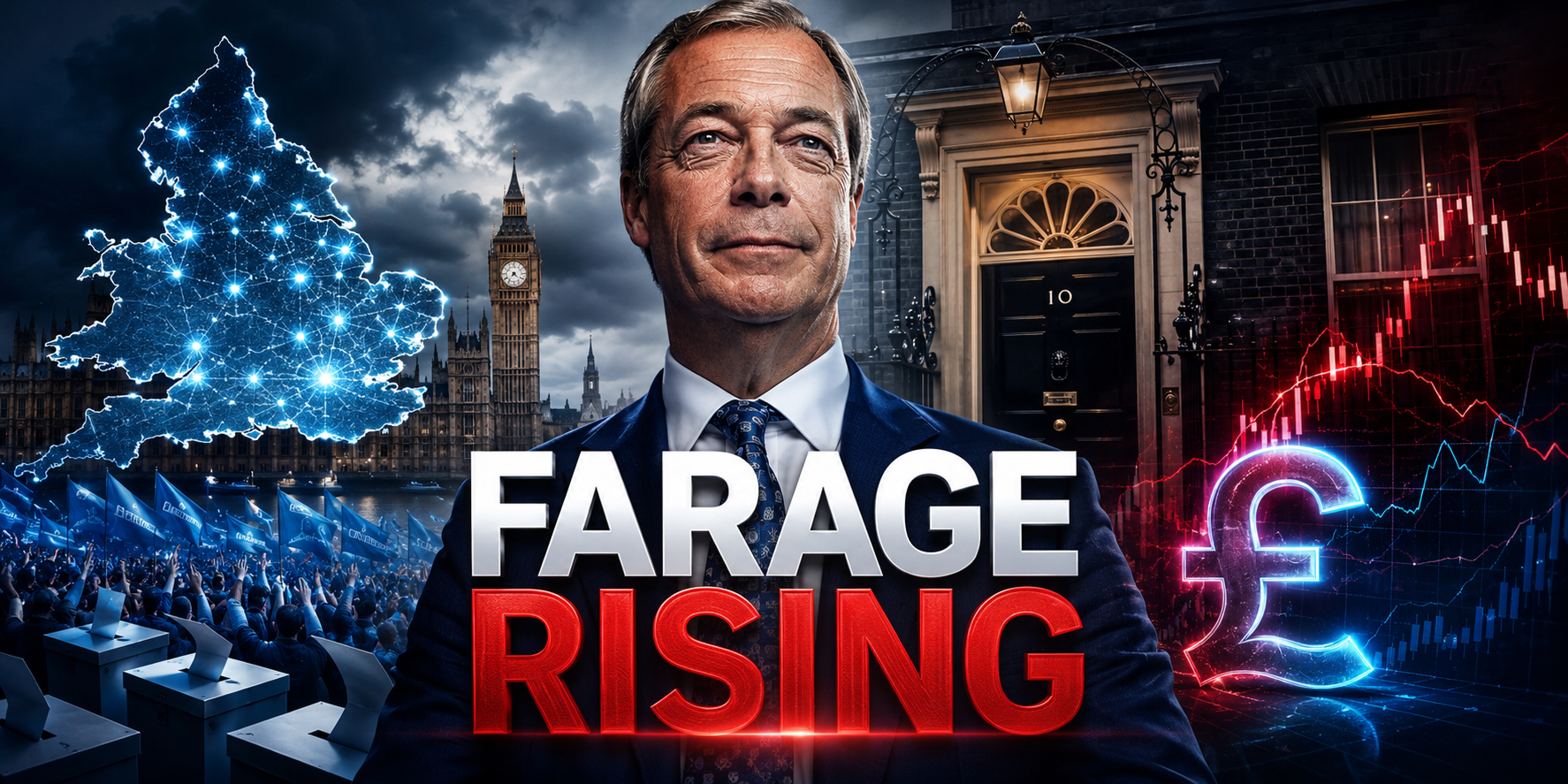
Reform UK's Local Election Sweep Is the Most Significant Shift in British Politics Since Brexit. Here's What They Control, What It Means for 2029, and What a Farage Government Would Do to UK Markets.
The results coming out of England's local elections today are not an incremental shift in British politics. They are a structural rupture. Nigel Farage's Reform UK has swept hundreds of council seats across England, toppling Labour in northern Red Wall strongholds it had held for half a century and gutting the Conservatives from the other side simultaneously. With counting still underway as of this writing, Reform has won enough seats to take control of both Suffolk County Council and Essex County Council — two of the largest local budgets in the country — and the final total is tracking toward a four-figure seat gain once all 136 councils have declared.
For investors, this is not just a political story. A Reform UK government — which, based on current polling, is now the most plausible outcome of the next general election — would carry profound implications for UK trade policy, the special relationship with the United States, UK-EU relations, and British financial markets. The question is no longer whether Farage is a serious contender. It is what British politics looks like with him in charge, and what that means for your portfolio.
🗳️ What Actually Happened Today
Elections for approximately 5,000 seats on 136 local councils across England represented the UK's most significant test of public opinion before the next general election. Here's the scoreboard as counting continues:
- Reform UK has surpassed 500 seat gains in England with counting still underway — the Politics UK ward-level projection puts Reform on course for approximately 1,580 seats once all results are declared
- In Wigan — one of Labour's most symbolic northern heartlands — Reform won 24 of the 25 seats that were up for election in this cycle; Labour lost all 22 seats it was defending (Wigan elects by thirds, so this refers to the seats contested in 2026, not the full council)
- In Tameside in Greater Manchester, Reform picked up all 14 seats Labour was defending, ending the party's nearly 50-year control of the council
- In Salford, Labour held on to just three of the 16 seats it was defending
- In Halton, Reform won 16 of the 19 seats being contested
- Labour has lost 338 seats so far; the Conservatives have lost 223
Sir John Curtice told the BBC there is "a pretty clear broad picture — however you look at it, Reform are in poll position." Early results suggest the UK's traditional two-party system is fracturing into a multi-party democracy, in what analysts say is one of the biggest transformations in British politics in the last century.
One subplot worth noting: Restore Britain — the new hard-right party launched by former Reform MP Rupert Lowe that was flagged as a potential vote-splitter on Reform's right flank — appears to have been a non-factor tonight. Reform's momentum simply steamrolled any fragmentation risk in these results. Whether Restore Britain becomes a meaningful spoiler ahead of the 2029 general election remains an open question, but tonight it was not a story.
📍 What Reform Actually Controls Now — And Why It Matters
Winning council seats isn't just symbolic. County councils manage social care, planning permissions, school services, and road infrastructure. Reform has won enough seats to control Essex County Council and Suffolk County Council — between them overseeing multi-billion-pound budgets and services for millions of residents. That foothold matters for three reasons investors should understand.
First, they now have a governing record to run on. The "too extreme to govern" argument — Labour and the Conservatives' most durable line of attack — gets stress-tested in real time before the next general election. A competent local government record is the most powerful rebuttal available to a party that has never held executive power at any level.
Second, they've built the infrastructure that was their biggest weakness. Local election victories recruit volunteers, build donor networks, and develop the political talent pipeline that major parties take decades to construct. Reform is doing in two years what normally takes a generation.
Third, the geography of their support is unusually efficient for the voting system they're operating in. Sir John Curtice noted Reform's vote is relatively evenly spread across England — which under the UK's first-past-the-post system translates more cleanly into parliamentary seats than geographically concentrated support does.
🗓️ The Path to 10 Downing Street: A Timeline
- July 2024: Labour wins a landslide. Reform wins five seats.
- 2024–2025: Reform surges in polling as Labour's cost-of-living approval craters. Becomes the largest party in national voting intention polls.
- May 2025: Reform wins 677 council seats, takes control of ten county councils including Kent, Lancashire, and Lincolnshire, and wins the Runcorn and Helsby parliamentary by-election by six votes. rt
- March 2026: Restore Britain formally registers as a party — introducing a potential vote-splitting risk on Reform's right flank that has not materialized in tonight's results
- April 2026: A PLMR/Electoral Calculus MRP poll finds the most likely outcome of an immediate election would be a Reform-Conservative coalition with Farage as Prime Minister and a working parliamentary majority of 44 seats Electoral Calculus
- May 8, 2026: Today. Reform sweeps England again — bigger, broader, and with governing control of major county councils for the first time.
Ladbrokes now makes Farage 7/2 to become the next Prime Minister, comfortably ahead of Labour's Andy Burnham and Wes Streeting at 6/1 apiece. The next general election must be held by 2029.
💷 What a Reform Government Would Actually Mean for UK Markets
The Special Relationship
Farage is Trump's most prominent ally in British politics — Trump once publicly floated him as a candidate for UK ambassador to Washington. A Farage government would arrive in Washington with pre-built personal relationships and ideological alignment that Starmer has had to manufacture carefully through diplomacy. The current US-UK Economic Prosperity Deal functions more as a framework for future action than a true free trade agreement — it is not legally binding and does not need to be approved by Congress or Parliament. A Farage-led Britain would be positioned to push that framework into something genuinely comprehensive. The full US-UK free trade agreement that eluded Trump's first administration and the Starmer government both would have its best political conditions yet.
UK-EU Relations — The Riskier Side
This is the sharper edge for markets. The Starmer government has spent 18 months threading a needle between EU rapprochement and US trade demands. A new Sanitary and Phytosanitary standards agreement announced in May 2026 significantly reduced paperwork for goods exporters and border checks — but any change to UK standards to satisfy US negotiations could impact that EU reset deal. Reform's platform calls for no further EU alignment and a hard line on Northern Ireland Protocol arrangements. The math is uncomfortable: the UK exported £184 billion of goods to the EU in 2024, versus £66 billion to the US. Renewed EU friction puts a far larger trade relationship at risk than the US gains would offset, at least in goods terms.
British Financial Markets — The Four Things to Watch
When the UK announced its intent to exit the EU in 2016, it triggered a sharp decline in the pound sterling and a fall in UK equity markets — however, the FTSE 100 recovered in short order as the weaker currency boosted exports and the profitability of UK multinational companies. A Reform election victory would likely follow the same playbook.
On sterling, the long-term direction under a Reform government is bearish. EU trade friction and the political uncertainty inherent in a hard pivot away from Brussels would weigh on the pound, likely more significantly than any boost from a closer Washington relationship.
On the FTSE 100, the picture is actually constructive. The index is heavily weighted toward multinationals with dollar and euro-denominated earnings — the same companies that benefited when the pound weakened after Brexit. A softer pound boosts their reported earnings, and a deeper US trade deal could open additional market access for the financial services and professional services firms that make up much of the UK's most valuable export sector.
On the FTSE 250, the calculus flips. This index is far more domestically exposed — packed with the mid-cap businesses in retail, housebuilding, and financial services that depend on UK economic conditions and EU supply chains. Renewed EU border friction hits this cohort hardest.
On UK gilts, the risk is highest. Reform's platform includes significant tax cuts, and independent analysts have consistently struggled to reconcile the numbers with the spending reductions proposed to fund them. Bond markets will demand a credible fiscal plan, and the absence of one would push gilt yields higher — raising borrowing costs for the government and squeezing the domestic economy in the process.
The Wildcard
There is a scenario — not the base case, but not negligible — in which a Farage-Trump axis finally delivers the comprehensive US-UK FTA that has been chased since 2016. The UK exported £135 billion of services to the US in 2024, with financial services and business consultancy among the largest categories. A full bilateral deal would be structurally significant for those sectors. The price: accepting US food safety standards the EU explicitly prohibits — forcing a direct choice between US and EU market access that the current government has been successfully avoiding.
📊 Bottom Line
Today's results are the most significant shift in British electoral politics since Brexit. Reform UK now controls major English county councils, is tracking toward a four-figure final seat total, and has demonstrated the geographic breadth of support that converts efficiently into parliamentary seats under first-past-the-post.
The investment case runs in two directions. A Reform government likely unlocks a deeper US-UK trade relationship with genuinely favorable political conditions in Washington — good for FTSE 100 multinationals and UK financial services exporters. The trade-off is renewed EU friction on the UK's larger trade relationship, sterling weakness, and gilt market pressure on a platform whose fiscal arithmetic has yet to be tested at the national level.
British political risk — which markets had been comfortably discounting since Labour's 2024 landslide — is back on the table. Farage has never been closer to Downing Street, and the distance is shrinking.
Sources
- Al Jazeera — UK Elections: Early Results and Takeaways: https://www.aljazeera.com/news/2026/5/8/uk-elections-early-results-and-takeaways-will-starmer-have-to-resign
- LGC Plus — Live Blog: Local Election Results 2026: https://www.lgcplus.com/politics/governance-and-structure/live-blog-local-election-results-2026-08-05-2026/
- Yahoo News UK — How Many Council Seats Reform Won: https://uk.news.yahoo.com/many-council-seats-reform-won-051545882.html
- Politics UK — 2026 Local Elections Prediction: https://politicsuk.com/news/2026-local-elections-prediction/
- ITV News Anglia — Reform Makes Sweeping Gains Across the East: https://www.itv.com/news/anglia/2026-05-07/the-local-elections-results-transforming-the-political-landscape-of-east-anglia
- Electoral Calculus / PLMR — MRP Poll April 2026: https://www.electoralcalculus.co.uk/blogs/ec_vipoll_20260423.html
- Ladbrokes — Next UK Prime Minister Odds: https://www.ladbrokes.com/en/news/next-uk-prime-minister-odds/
- YouGov MRP — Reform UK Government a Near-Certainty: https://yougov.com/en-gb/articles/53059-yougov-mrp-shows-a-reform-uk-government-a-near-certainty-if-an-election-were-held-tomorrow
- Wikipedia — 2026 United Kingdom Local Elections: https://en.wikipedia.org/wiki/2026_United_Kingdom_local_elections
- Wigan Council — Elections Page: https://www.wigan.gov.uk/council/voting-and-elections/elections.aspx
- UK Parliament Commons Library — US Trade Tariffs: https://commonslibrary.parliament.uk/research-briefings/cbp-10240/
- German Marshall Fund — The US-UK Economic Prosperity Deal: https://www.gmfus.org/news/us-uk-economic-prosperity-deal
- Mellon Investments — Market Impacts of Brexit and US Tariff Declaration: https://www.mellon.com/insights/insights-articles/deja-vu--the-market-impacts-of-brexit-and-united-states-tariff-d.html
Market Munchies and Mode Mobile communications are for informational purposes only, and are not a recommendation, solicitation, or research report relating to any investment strategy, security, or digital asset. All investments involve risk including the loss of principal and past performance does not guarantee future results.
Any information contained in this commentary does not purport to be a complete description of the securities, markets, or developments referred to in this material. The information has been obtained from sources considered to be reliable, but we do not guarantee that the foregoing material is accurate or complete. There is no guarantee that any statements or opinions provided herein will prove to be correct.