
Stablecoins Eye $1 Trillion Market Cap as Yield Tokens Reshape Industry
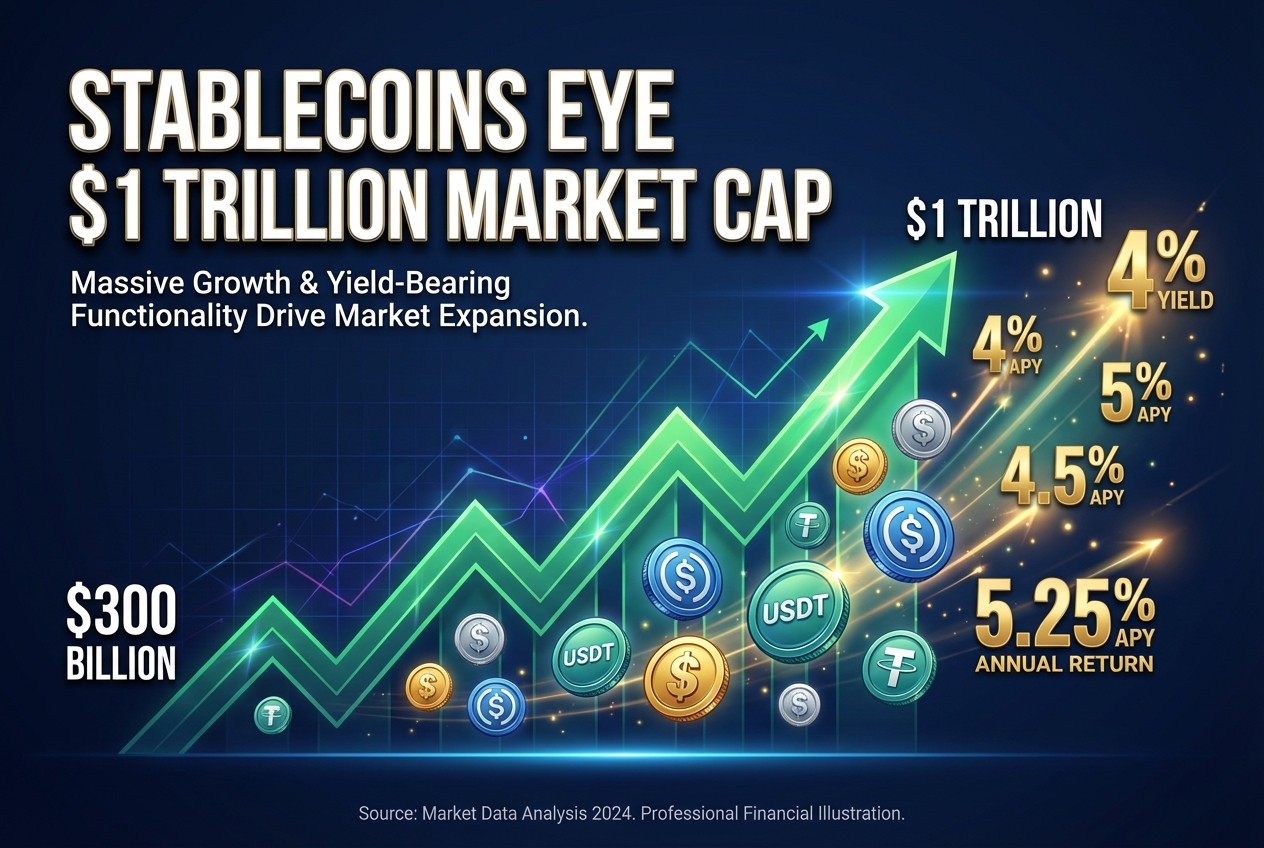
📈 The Trillion-Dollar Forecast Taking Shape The stablecoin market is poised to more than triple in 2026, reaching $1 trillion according to 21Shares projections . This ambitious forecast represents a massive leap from the current $300 billion market cap that stablecoins…
📈 The Trillion-Dollar Forecast Taking Shape
The stablecoin market is poised to more than triple in 2026, reaching $1 trillion according to 21Shares projections. This ambitious forecast represents a massive leap from the current $300 billion market cap that stablecoins achieved throughout 2025. Alisia Painter, co-founder and chief operating officer of Bitcoin DeFi builder Botanix Labs, points to yield-bearing stablecoins as the primary catalyst. The prediction is particularly striking when considering the stablecoin market took five years to grow from $28 billion in 2020 to roughly $280 billion in 2025. Now, experts anticipate adding another $700 billion in just one year. For investors, this growth trajectory signals a fundamental shift in how dollar-pegged assets function in crypto markets. Traditional stablecoins like USDT and USDC dominated the first wave, but the next phase appears centered on tokens that blend stability with returns. The market dynamics suggest institutional capital will drive much of this expansion as regulatory clarity emerges.
💰 Yield-Bearing Tokens Drive The Shift
Yield-bearing stablecoins are fundamentally changing what investors expect from dollar-pegged crypto assets. These tokens maintain their $1 peg while generating passive income through mechanisms like DeFi lending or backing with real-world assets such as U.S. Treasuries. JPMorgan predicts these yield variants could capture 50% of the stablecoin market share, a dramatic shift from today's landscape where they represent roughly 4.5% of supply. The appeal is straightforward for holders. Traditional stablecoins pay zero interest, meaning investors holding them missed out on an estimated $9 billion in yearly yield even as U.S. interest rates hover near 4-5%. Yield-bearing variants close this gap by passing returns directly to token holders. Three dominant models have emerged in 2025. Tokenized treasury products back stablecoins with short-term government bonds. DeFi wrapper protocols like Sky (formerly MakerDAO) automatically grow balances through savings modules. Synthetic approaches like Ethena's USDe use delta-neutral futures strategies to capture funding rate yields. For traders, these innovations mean stablecoins are no longer just settlement tools but productive assets in their own right.
⚖️ Regulatory Frameworks Create Growth Foundation
Regulatory clarity in major markets is removing a key barrier to stablecoin adoption at scale. The United States passed the GENIUS Act on July 18, 2025, establishing the first comprehensive stablecoin legislation in the country. The law requires issuers to maintain 1:1 reserves in low-risk assets like physical currency, U.S. Treasury bills, and approved repurchase agreements. Once circulation exceeds $10 billion, issuers must graduate to direct federal oversight by the Federal Reserve, OCC, or NCUA. Notably, the GENIUS Act bans yield-bearing stablecoins, creating a stark contrast with Europe's approach. The European Union's Markets in Crypto-Assets Regulation (MiCA) came into force December 30, 2024, regulating both e-money tokens backed by single fiat currencies and asset-referenced tokens backed by baskets. Both frameworks grant holders redemption rights at par and require conservative reserve ratios. For institutional investors, these rules provide the legal certainty needed to deploy significant capital. However, the differing approaches are fragmenting global stablecoin liquidity pools along jurisdictional lines, potentially introducing new cross-border settlement frictions.
🏦 Institutional Adoption Accelerates Market Growth
Institutional players are increasingly viewing stablecoins as essential infrastructure for digital finance. The combination of regulatory frameworks and yield-bearing functionality addresses two major institutional concerns: legal compliance and capital efficiency. Banks, asset managers, and payment processors that previously sat on the sidelines now have clearer paths to participation. Cross-border payments represent a particularly compelling use case for institutional adoption. Traditional international transfers can take days and incur substantial fees, while stablecoin transfers settle in minutes at minimal cost. This efficiency gain becomes even more attractive when the stablecoins themselves generate yield during settlement periods. Payment giants and financial institutions are exploring stablecoin integration for treasury management and client services. The market opportunity extends beyond simple transfers. Institutional demand for tokenized assets is projected to reach $500 billion by 2026, creating natural synergies with stablecoin infrastructure. For investors, watching institutional custody solutions and banking partnerships will signal how quickly this adoption curve materializes. The shift from retail-dominated to institutionally-backed stablecoins could fundamentally alter market dynamics and stability characteristics.
⚠️ Risks and Challenges Remain
Despite optimistic forecasts, yield-bearing stablecoins carry risks that could slow adoption or trigger market disruptions. Smart contract vulnerabilities represent a technical concern, as these tokens rely on complex code to generate and distribute returns. A single exploit in a major protocol could shake confidence across the sector. Market dependency creates another challenge. Higher-yielding stablecoins often rely on crypto market structure like funding spreads and hedging strategies, which can evaporate during market stress. Conservative designs backed by treasuries face lower yields but maintain stability, while aggressive strategies offer better returns at higher risk. The regulatory landscape remains uncertain despite recent progress. Yield-bearing products resemble securities in many jurisdictions, potentially inviting additional oversight or restrictions. The divergence between U.S. and European frameworks creates compliance complexity for global issuers. Off-chain dependencies add another layer of risk. Stablecoins backed by real-world assets must trust banks, custodians, and brokers beyond blockchain's trust-minimized environment. For traders, understanding these risk tradeoffs is essential. The $1 trillion forecast assumes favorable conditions, but macro shifts, regulatory changes, or protocol failures could significantly alter the trajectory.
🎯 Investor Implications and Market Outlook
The projected tripling of stablecoin market cap to $1 trillion by 2026 represents more than just numerical growth. It signals a maturation of crypto infrastructure where dollar-pegged assets become productive financial instruments rather than static settlement tools. Investors should watch several key indicators to gauge whether this forecast materializes. First, monitor yield-bearing stablecoin supply growth. Current estimates put this segment at roughly $11 billion out of $300 billion total, so reaching JPMorgan's 50% market share prediction requires explosive growth in the next year. Second, track institutional partnerships and custody solutions as signals of enterprise adoption. Third, observe regulatory developments beyond initial frameworks, particularly regarding securities classification of yield products. The longer-term outlook varies widely among forecasters. Citi's base case projects $1.9 trillion by 2030, while Standard Chartered predicts $2 trillion by 2028. Conservative scenarios anchor near $1 trillion by 2026, with upside cases reaching higher. For portfolio positioning, stablecoins are evolving from simple cash equivalents to a distinct asset class. The combination of stability, yield, and regulatory clarity could make them attractive for both crypto-native traders and traditional finance participants seeking efficient dollar exposure. The next 12 months will test whether infrastructure, demand, and regulatory support can deliver on the trillion-dollar vision.
Sources
https://www.cryptotimes.io/2025/12/11/21shares-forecasts-1t-stablecoins-500b-tokenized-assets-in-2026/ https://beincrypto.com/learn/yield-bearing-stablecoins/ https://www.weforum.org/stories/2025/07/stablecoin-regulation-genius-act/ https://www.visualcapitalist.com/visualized-stablecoin-market-size-forecast-into-2030/ https://www.bitrue.com/blog/stablecoin-market-forecast-2026-yield-bearing-adoption
Market Munchies and Mode Mobile communications are for informational purposes only, and are not a recommendation, solicitation, or research report relating to any investment strategy, security, or digital asset. All investments involve risk including the loss of principal and past performance does not guarantee future results.
Any information contained in this commentary does not purport to be a complete description of the securities, markets, or developments referred to in this material. The information has been obtained from sources considered to be reliable, but we do not guarantee that the foregoing material is accurate or complete. There is no guarantee that any statements or opinions provided herein will prove to be correct.
Get fresh insights, breaking news, and hidden gems in the world of crypto—delivered straight to your inbox with our Crypto Cookies newsletter. Don’t miss out—sign up now and get your first bite of insider knowledge!