
The FDA Just Approved Mango and Blueberry Vapes. Here's What Really Changed — and What It Means for Investors.
After Years of Banning Every Flavor That Wasn't Tobacco or Menthol, the FDA Just Changed Course. Here's Why It Matters. For four years, the FDA maintained a near-absolute position: e-cigarettes could only be sold in tobacco or menthol flavors. Every fruit, candy, and dessert…
After Years of Banning Every Flavor That Wasn't Tobacco or Menthol, the FDA Just Changed Course. Here's Why It Matters.
For four years, the FDA maintained a near-absolute position: e-cigarettes could only be sold in tobacco or menthol flavors. Every fruit, candy, and dessert flavor that made vaping appealing to younger users was denied authorization, rejected, or seized. The agency pulled Juul's products entirely in 2022 before a court reversal allowed the company to keep selling.
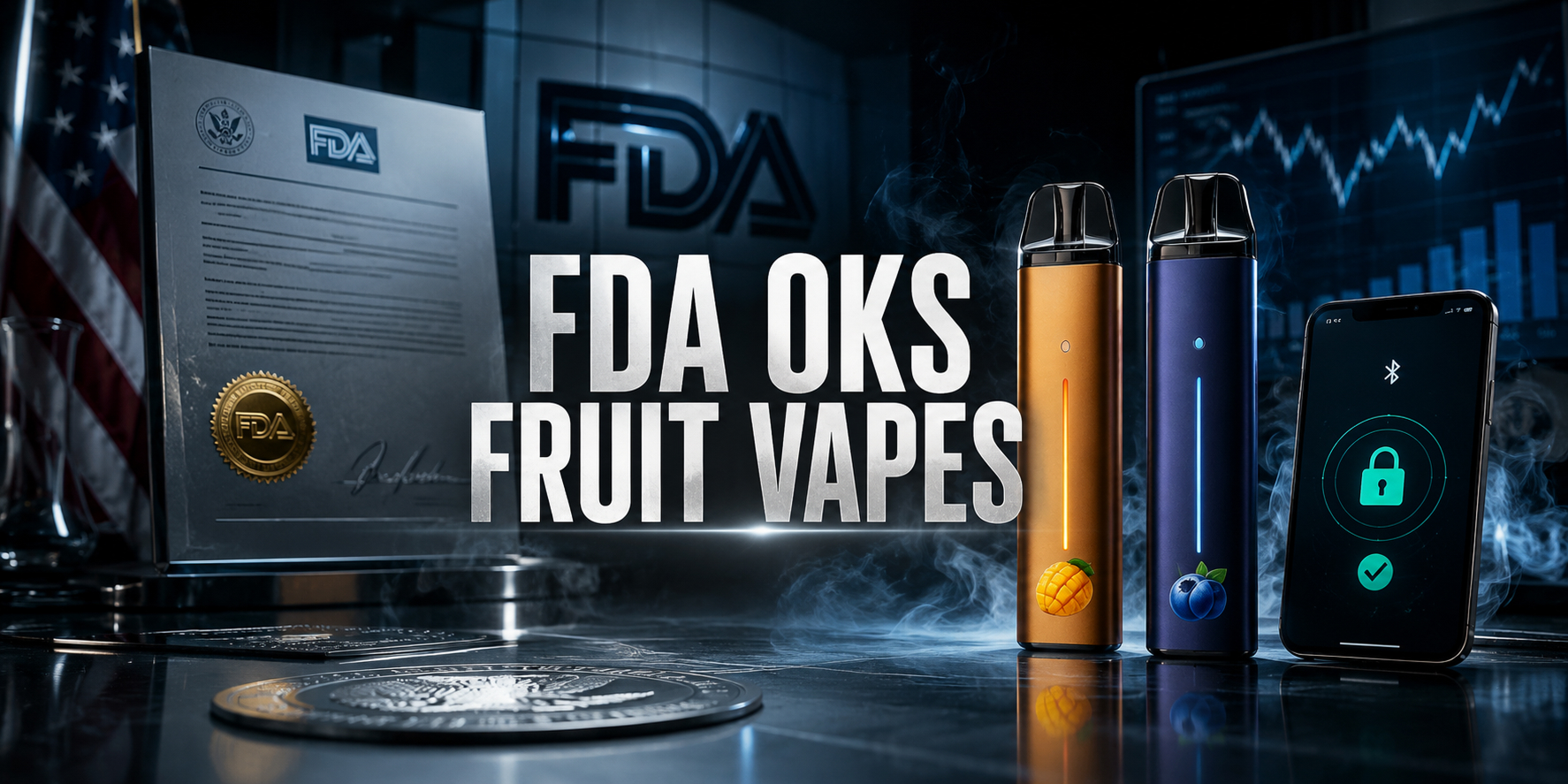
This week, under the Trump administration, the FDA announced its first authorization of fruit-flavored electronic cigarettes intended for adult smokers — a major policy shift after months of appeals from the vaping industry.
The vaping wars never really ended. They just changed sides.
📋 What Actually Changed This Week
Previously, the FDA had only granted permission to tobacco or menthol-flavored vaping products. Most e-cigarettes approved by regulators come from large manufacturers, including Juul and Altria.
The new authorization — the first of its kind — covers specific fruit-flavored products from Glas Inc., specifically mango and blueberry flavored devices, that went through the FDA's Premarket Tobacco Product Application process. Crucially, these aren't conventional vapes. The Glas products authorized this week use Bluetooth-enabled age verification — the device cannot be used unless it is paired to a smartphone app that has verified the user's ID. That technological compromise is the specific reason the FDA said yes. It wasn't a simple change of regulatory philosophy in isolation — it was a philosophy change enabled by a technical solution that addresses the teen access concern the FDA has been citing for years.
This is not a blanket legalization of fruit-flavored vapes. What it signals is a new FDA framework under Commissioner Marty Makary — a surgeon and author who built his reputation critiquing medical bureaucracy and was specifically chosen by the Trump administration to bring a more permissive, adult-choice philosophy to the agency — and the Trump administration: fruit-flavor authorizations are achievable, but manufacturers must demonstrate both that adults benefit and that technology actively prevents youth access — not just that disclaimers exist.
One historical clarification worth making: the FDA's shift this week is specifically from tobacco-and-menthol to fruit flavors. Menthol's history is slightly more complicated — the FDA actually authorized several menthol-flavored e-cigarette products in 2024 and 2025 under the Biden administration, making menthol a settled category rather than a newly permissive one. The genuinely new ground broken this week is fruit, which had been the flavor category facing the highest evidentiary burden and the most consistent denials.
🗂️ The Juul Timeline You Need to Know
Understanding this week's news requires understanding how we got here.
- 2015-2018: Juul dominates the U.S. e-cigarette market, capturing more than 70% market share. Teen vaping rates surge. Congressional hearings follow.
- September 2020: FDA deadline for all e-cigarette manufacturers to submit Premarket Tobacco Product Applications. Companies without approved applications must stop selling.
- June 2022: FDA denies Juul's PMTA, ordering it to stop selling all products in the U.S. — citing insufficient evidence to assess toxicological risks.
- June 2022: A federal court immediately issues a stay of the denial, allowing Juul to keep selling while the legal challenge proceeds.
- July 2025: The FDA authorized Juul to keep its e-cigarettes on the market, saying studies show its e-cigarettes are less harmful for adult smokers who switch completely to vaping. The authorization covered tobacco and menthol flavors only. Juul is now widely considered the next major manufacturer in line for a fruit-flavor authorization — the company's Juul2 and Juul3 platforms, already sold in the UK and Canada, use age-verification technology similar to Glas's Bluetooth solution, giving them a credible pathway through the new framework.
- March 2026: The FDA released new draft guidance that could allow flavored vapes in categories like mint, coffee, tea, and spices to pursue PMTA authorization.
- May 2026: First fruit-flavor authorization announced. The dam breaks.
🚨 The Enforcement Gap Nobody Is Talking About
Here's the part of the vaping story that gets lost in the regulatory headlines.
About 6,000 e-cigarette products are sold in the U.S., but just 41 have been authorized for sale by the FDA. That means the overwhelming majority of what is actually being sold in gas stations, convenience stores, and vape shops across the country is technically illegal.
The GAO examined this problem in an April 2026 report. The findings were stark. Most DOJ enforcement actions between fiscal year 2022 and fiscal year 2025 — 50 out of a total of 88 — were simply to add the names of remote e-cigarette sellers to a list of unauthorized businesses. Not prosecutions. Not seizures. A list.
The FDA "has not gotten the support from law enforcement agencies, starting with the Justice Department, that is needed to aggressively enforce against illicit vaping products," said Mitch Zeller, who led the FDA's tobacco division from 2013 to 2022.
The practical result: a two-tier market where established manufacturers like Juul navigate years of expensive PMTA review to get products authorized, while thousands of illegal competitors — many of them Chinese-manufactured disposable devices in fruit and candy flavors — sell freely at the corner store with essentially no consequence.
⚖️ The Central Tension: Teen Protection vs. Adult Choice
The FDA's original fruit-flavor ban was built on a specific concern: fruit and candy flavors are disproportionately appealing to teenagers, and authorizing them creates a gateway to nicotine addiction among young people who never smoked.
That concern has not disappeared. Fruit, candy, and dessert flavors still face the highest evidentiary burden under the new draft guidance. Manufacturers seeking authorization for those flavors must demonstrate not just that adults benefit, but that the marketing and product design don't disproportionately appeal to youth.
The Trump administration's philosophy is different. Vaping industry advocates spent months lobbying the White House for a more permissive approach, arguing that adult smokers deserve access to a wider range of products that might help them quit cigarettes — and that the flavor ban primarily served to push adult vapers toward the illegal market rather than protect teenagers.
Both arguments contain genuine merit. That's what makes this a genuinely difficult regulatory problem rather than an obvious call in either direction.
💼 What It Means for Investors
The immediate beneficiaries of a more permissive FDA flavor policy are the established manufacturers with products already in the PMTA pipeline.
Altria — which owns a 35% stake in Juul — has been watching its investment decline for years as Juul navigated regulatory uncertainty. A clearer path to fruit-flavor authorization for established manufacturers is directly positive for the Juul stake's value.
British American Tobacco — which makes Vuse, currently the market share leader in authorized U.S. e-cigarettes — is similarly positioned to benefit from expanded flavor authorizations, having invested heavily in PMTA compliance for its product line.
Reynolds American (owned by BAT) and NJOY (acquired by Altria) are the other established players with authorized products and the infrastructure to bring new flavors through the PMTA process.
The companies least benefited by this shift are the illegal importers and domestic manufacturers of unauthorized disposable vapes — who have been competing without regulatory costs and will now face a market where their legal competitors have more attractive products.
The longer-term question is whether expanded legal authorization actually reduces teen vaping — by satisfying adult demand without the black market — or increases it by normalizing flavor variety. That question won't be answered by this week's FDA decision. It'll be answered by the data over the next three to five years.
Sources
- NBC News — "FDA announces its first OK of fruit-flavored e-cigarettes for adults in major shift under Trump": https://www.nbcnews.com/health/health-news/fda-announces-first-ok-fruit-flavored-e-cigarettes-adults-major-shift-rcna343777
- CNBC — "FDA announces its first approval of fruit-flavored e-cigarettes for adults": https://www.cnbc.com/2026/05/06/fda-announces-first-approval-of-fruit-flavored-e-cigarettes-adults.html
- PBS NewsHour / AP — "Juul can continue selling e-cigarettes as FDA says vaping benefits outweigh risks": https://www.pbs.org/newshour/health/juul-can-continue-selling-e-cigarettes-as-fda-says-vaping-benefits-outweigh-risks
- FDA — "FDA Denies Authorization to Market JUUL Products" (2022 original denial): https://www.fda.gov/news-events/press-announcements/fda-denies-authorization-market-juul-products
- FDA — CTP Newsroom (authorization history): https://www.fda.gov/tobacco-products/ctp-newsroom
- STAT News — "GAO report shows gap between scale of illegal vapes and enforcement": https://www.statnews.com/2026/04/10/illegal-vapes-gao-report-shows-insufficient-enforcement-fda/
- RxVape — "What Vapes Are FDA Approved? FDA-Authorized Vape Brands 2026": https://rxvape.com/2026/02/19/fda-authorized-vape-brands-2026/
- VapeMaison — "2026 E-Cigarette Market Trends: Technology, Regulations & Consumer Preferences": https://vapemaison.com/2026-e-cigarette-market-emerging-trends-regulations-and-evolving-consumer-preferences/
Market Munchies and Mode Mobile communications are for informational purposes only, and are not a recommendation, solicitation, or research report relating to any investment strategy, security, or digital asset. All investments involve risk including the loss of principal and past performance does not guarantee future results.
Any information contained in this commentary does not purport to be a complete description of the securities, markets, or developments referred to in this material. The information has been obtained from sources considered to be reliable, but we do not guarantee that the foregoing material is accurate or complete. There is no guarantee that any statements or opinions provided herein will prove to be correct.