
The Jobs Report Just Landed. 115,000. Here's What It Actually Means.
Wall Street Expected 55,000. The Economy Delivered 115,000. Now the Fed Has a New Problem. Wall Street was bracing for 55,000. The economy delivered 115,000. For the second month in a row, the U.S. labor market beat forecasts badly enough to force a reassessment of the…
Wall Street Expected 55,000. The Economy Delivered 115,000. Now the Fed Has a New Problem.
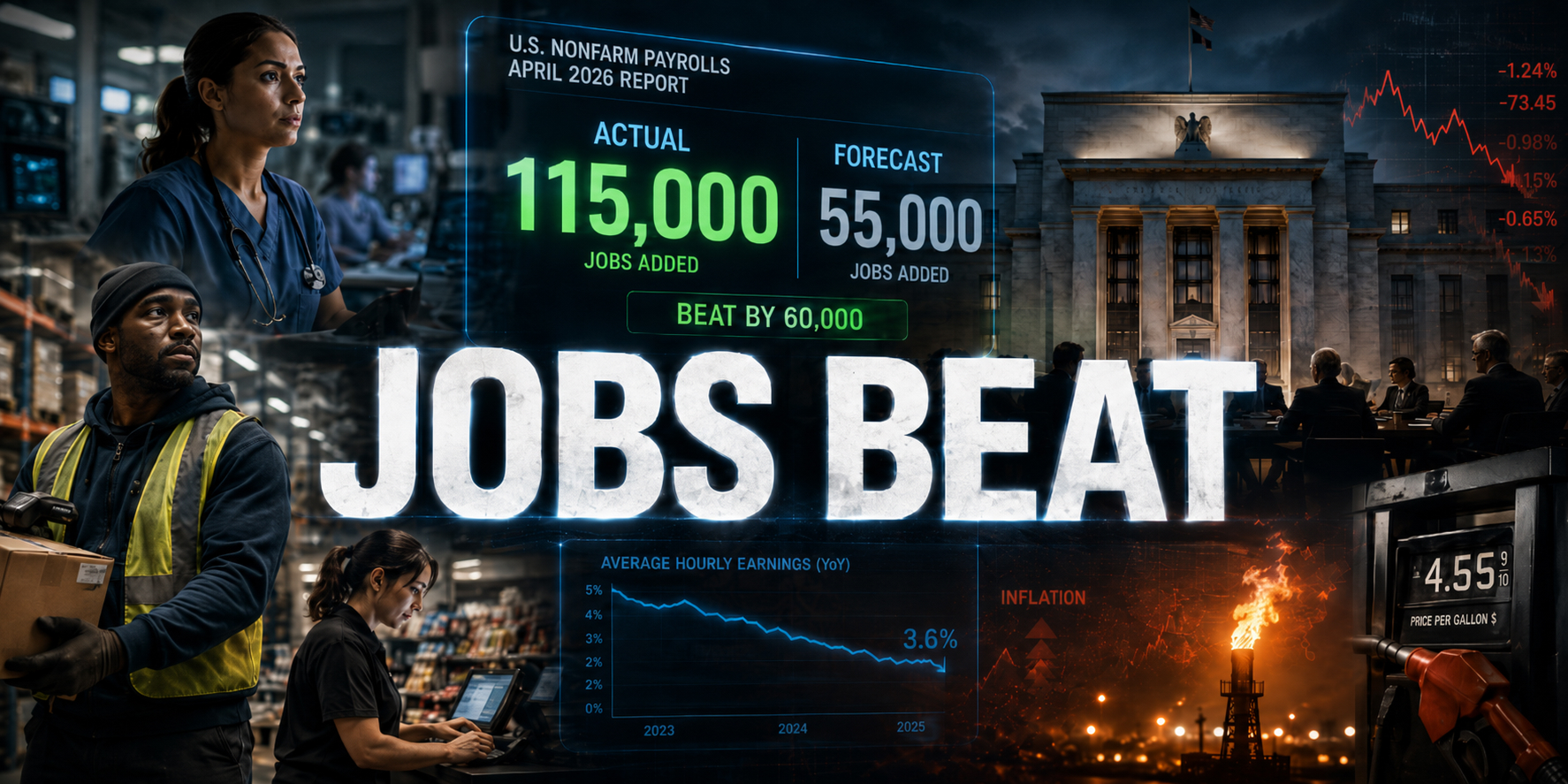
Wall Street was bracing for 55,000. The economy delivered 115,000. For the second month in a row, the U.S. labor market beat forecasts badly enough to force a reassessment of the stagflation narrative — and create a new problem for the Federal Reserve heading into Kevin Warsh's first meeting on June 17.
📊 The Numbers at a Glance
- Nonfarm payrolls (April): +115,000 — beat consensus of 55,000 by more than double
- March revision: upward to 185,000 from 178,000
- Unemployment rate: 4.3% — held steady, as expected
- Average hourly earnings MoM: +0.2% — below the 0.3% estimate
- Average hourly earnings YoY: +3.6% — below the 3.8% estimate
- February revision: down to -156,000 from -133,000
The headline beat is unambiguous. The wage softness is the nuance that matters most for the Fed.
🏥 Where the Jobs Actually Came From
The sector breakdown tells a familiar story with one new wrinkle.
Healthcare: +37,000. For the third consecutive month, healthcare dominated job creation. This is the structural labor market story of 2026 — an aging population creating sustained, recession-resistant demand for medical workers that neither the Iran war nor the energy shock has dented. AI penetration in healthcare remains limited compared to other sectors, which means the human hiring cycle is intact.
Transportation and warehousing: +30,000. The strongest single-month gain for this sector since late 2024. Counterintuitive given the Hormuz closure's disruption to global shipping, but consistent with the front-running dynamic we identified in the Q1 GDP analysis: companies stockpiling imported goods ahead of tariff escalations and supply disruptions are generating domestic warehousing demand even as international shipping shrinks.
Retail trade: +22,000. A genuine surprise. Consumer spending data has been softening, gas prices are at $4.55 per gallon nationally, and the savings rate has declined to a four-year low. A 22,000 retail gain suggests the hiring is likely concentrated in discount and value retail — Walmart, Dollar General, Five Below — where consumer trade-down activity is generating genuine traffic increases as households shift spending away from premium brands and toward the cheapest available alternative. This is not a sign that the consumer is doing well. It is a sign that the consumer is adapting to doing worse.
Federal government: -9,000. Federal employment has now declined for six consecutive months, reflecting the ongoing DOGE-related workforce reduction. Since October 2024, federal government employment is down approximately 355,000, or nearly 12%. That structural headwind has been a persistent drag on the headline payroll number throughout 2026.
Information: -13,000. The most significant negative in the report. Information sector job losses — which include technology and media — are consistent with the AI-driven efficiency story we covered in the Cloudflare earnings piece yesterday: companies laying off workers explicitly because AI has reduced their headcount requirements.
💰 The Wage Number Is the Fed Story
The headline beat will get the attention. The wage miss is what Warsh will be reading on the plane.
Average hourly earnings rose just 0.2% month over month — below the 0.3% estimate — and 3.6% year over year, below the 3.8% forecast. In the context of PCE running at 3.5% and core PCE accelerating on a quarterly basis, wage growth of 3.6% means real wages are essentially flat for the average worker — and actively negative for lower-income households. The national PCE average of 3.5% masks the distributional reality: the New York Fed found that lower-income households are spending 4.2% of their income on gasoline alone, up from 3.9% a year earlier. For a household earning $35,000, 3.6% nominal wage growth against a personal energy cost that is running well above 3.5% is not a wash. It is a pay cut. The "flat real wages" framing is accurate in aggregate. It understates the squeeze at the bottom of the income distribution.
That is simultaneously good news and bad news for the Fed.
The good news: wage inflation is not accelerating. The wage-price spiral that central banks most fear — where higher wages feed higher prices, which feed higher wage demands, in an self-reinforcing loop — is not visible in this data. Wage growth decelerating while headline payrolls beat is a relatively benign combination.
The bad news: with PCE at 3.5% and core PCE accelerating, a 3.6% wage gain means the inflation the Fed is fighting is almost entirely supply-side — driven by energy costs from the Hormuz closure — rather than demand-side. Supply-side inflation cannot be fixed by raising interest rates. The Fed's tools work on demand. They cannot reopen the Strait of Hormuz.
That constraint is precisely why the three hawkish dissenters from the April FOMC vote — who wanted to remove the easing bias from the policy statement — are in a difficult position. The data is not giving them the demand-driven inflation story that would justify a hike. But it is not giving the doves the labor market weakness that would justify a cut either.
🤔 The Interpretation Problem
Here is the honest read on what 115,000 jobs in April tells us about the Iran war's economic impact: almost nothing yet.
The Bureau of Labor Statistics' report will land at a moment when gas hovers around $4.55 per gallon, up 50% since the war started in late February. But the April survey reference period — the pay period including the 12th of the month — captures hiring decisions made in early April, when the war had been running for roughly five weeks and the most acute energy shock was still feeding through supply chains rather than appearing in corporate layoff decisions.
The labor market is a lagging indicator at the best of times. Companies do not lay people off the week oil hits $100. They cut capital expenditure, reduce hiring plans, and wait to see if conditions normalize. If the Hormuz closure persists through Q2 — which Trump's "might not happen" peace deal language suggests is plausible — the May and June payroll reports will show what the April data cannot: whether the energy shock is finally showing up in employment.
The "low fire, low hire" dynamic that economists flagged in the preview notes is the correct frame — and worth unpacking for anyone who hasn't encountered the phrase. It describes a labor market where companies are too nervous to fire workers (because rehiring is expensive and labor is still relatively scarce) but too uncertain to hire aggressively (because the economic outlook is murky). The result is a labor market that looks resilient on the surface — unemployment stays low, payrolls stay positive — but is quietly stagnating beneath the headline numbers. The labor market is not healthy in the way a pre-war, pre-shock labor market was healthy. It is resilient in the sense that it is not yet breaking — a meaningful distinction when you are trying to assess recession risk.
📈 What This Means for Markets and the Fed
For equity markets: A 115,000 beat on a 55,000 consensus removes the last remaining argument for a June cut. Markets had been pricing approximately 28% odds of a June cut ahead of this report. That probability will fall further when the CME FedWatch tool updates. Equities are likely to interpret this as "no imminent recession, no imminent cut" — a modestly positive backdrop that allows the peace-deal optimism driving yesterday's rally to continue without a labor market counterweight.
For the Fed: The June 17 meeting — the first under Kevin Warsh's chairmanship — now looks like a very clean hold. The labor market is not weak enough to justify a cut. Inflation is not demand-driven enough to justify a hike. The one scenario that could force Warsh's hand before September is a further acceleration in core PCE on the May 28 report, combined with the Hormuz closure persisting into its fourth month.
For the Iran deal calculus: The jobs beat reduces the domestic economic urgency of a peace deal marginally. A labor market delivering 115,000 jobs in the first full month of the energy shock does not look like an economy in crisis. That gives Trump slightly more negotiating room to hold out for better terms — which may explain his "might not happen, but could happen any day" framing from yesterday.
🔮 What to Watch Next
May 28 — March PCE revised / April PCE: The next inflation data point that will determine whether the hawkish dissenters' position strengthens or softens. If core PCE accelerates further from 3.2%, the rate hike probability moves meaningfully higher.
June 17 — First Warsh FOMC meeting: The new chair's first policy decision. Based on today's data, the base case is a hold with no change to the easing bias language. Whether Warsh removes the easing bias — as the three dissenters wanted in April — is the most watched single policy decision of the year.
The May jobs report (June 6): The first payroll report to capture a full two months of Iran war conditions. If the Hormuz closure continues through May, the May report is where the energy shock will start showing up in hiring decisions in sectors beyond information.
Sources
- CNBC — "Jobs report April 2026: Nonfarm payrolls rose 115,000": https://www.cnbc.com/2026/05/08/jobs-report-april-2026.html
- Trading Economics — "United States Non Farm Payrolls (April 2026)": https://tradingeconomics.com/united-states/non-farm-payrolls
- Kiplinger — "April Jobs Report Shows Labor Market Remains Steady": https://www.kiplinger.com/investing/economy/jobs-report-april-2026-what-to-expect
- NBC News — "April jobs report expected to show gains despite Iran war pressure": https://www.nbcnews.com/business/economy/april-jobs-report-iran-war-pressure-rcna344166
- PBS NewsHour — "U.S. job openings largely unchanged in March despite Iran conflict": https://www.pbs.org/newshour/economy/u-s-job-openings-largely-unchanged-in-march-despite-iran-conflict
- BLS — "Employment Situation, March 2026": https://www.bls.gov/news.release/archives/empsit_04032026.htm
- CME Group — FedWatch Tool: https://www.cmegroup.com/markets/interest-rates/cme-fedwatch-tool.html
Market Munchies and Mode Mobile communications are for informational purposes only, and are not a recommendation, solicitation, or research report relating to any investment strategy, security, or digital asset. All investments involve risk including the loss of principal and past performance does not guarantee future results.
Any information contained in this commentary does not purport to be a complete description of the securities, markets, or developments referred to in this material. The information has been obtained from sources considered to be reliable, but we do not guarantee that the foregoing material is accurate or complete. There is no guarantee that any statements or opinions provided herein will prove to be correct.