
The Market Calm Is Starting to Crack
Wall Street opened under pressure Tuesday as investors digested a hotter-than-expected April inflation report, another jump in oil prices, and fresh uncertainty around the U.S.-Iran ceasefire. The S&P 500 and Nasdaq had closed at record highs on Monday, but the tone shifted…
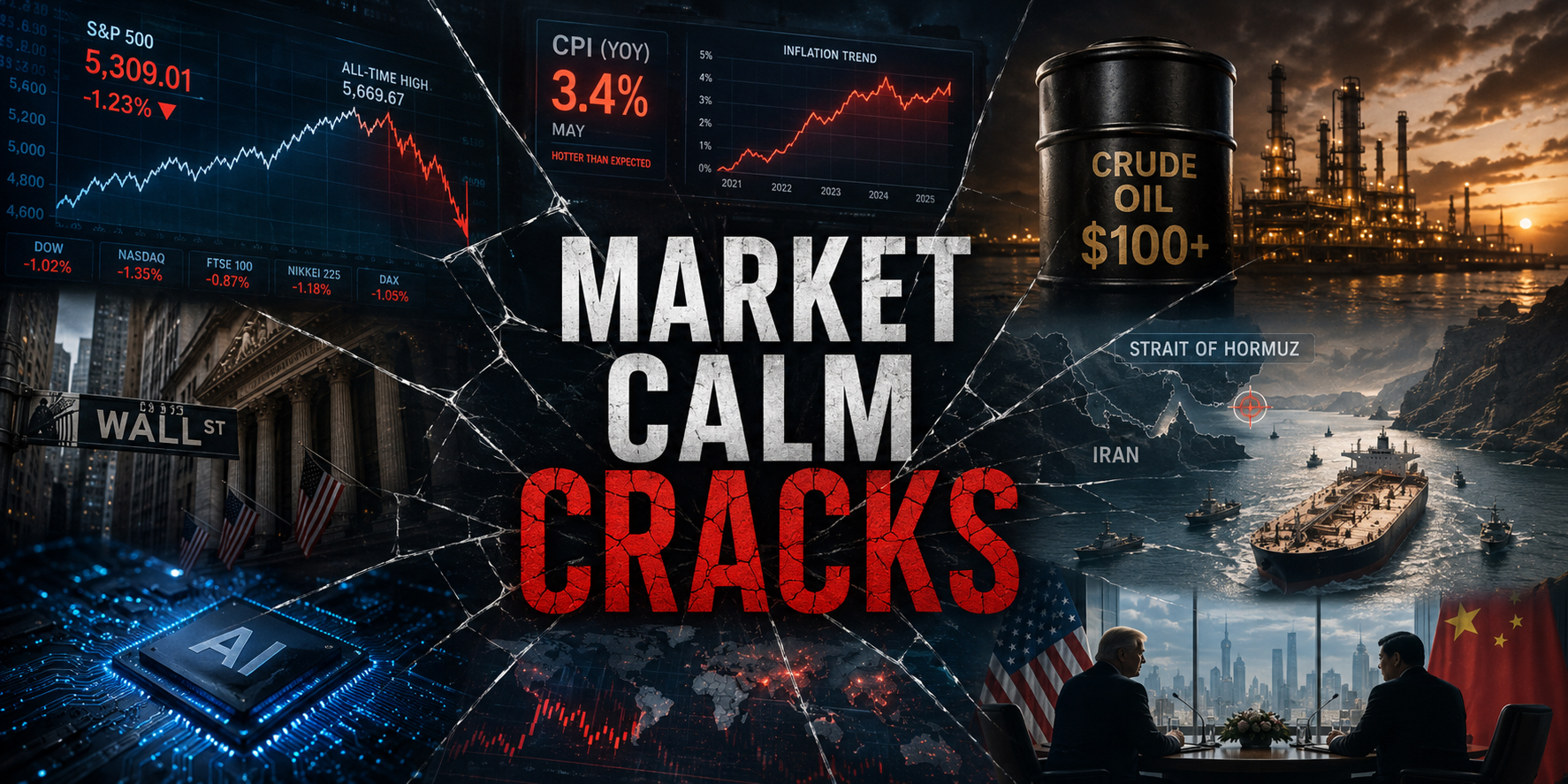
Wall Street opened under pressure Tuesday as investors digested a hotter-than-expected April inflation report, another jump in oil prices, and fresh uncertainty around the U.S.-Iran ceasefire. The S&P 500 and Nasdaq had closed at record highs on Monday, but the tone shifted quickly after consumer prices showed inflation moving in the wrong direction again. This is not a panic tape. It is a repricing tape. The market is still supported by resilient earnings, a durable labor market, and optimism around AI-driven growth. But the list of complications is getting harder to ignore: oil is back above $100, inflation is no longer cooling cleanly, ceasefire talks remain fragile, and President Trump is heading into a high-stakes meeting with Chinese President Xi Jinping later this week. The result is a market that still wants to believe in a soft landing but is being forced to confront a messier path. Today's five signals explain why the calm is starting to crack — and what investors should watch next.
Stock of Interest Today: Eastern Bankshares (EBC)
Eastern Bankshares looks like a very different company than it did a year ago. The Massachusetts-based lender completed its acquisition of HarborOne Bancorp on November 1, 2025, in a deal valued at approximately $490 million. The transaction added roughly $5.7 billion in assets, expanded Eastern's presence into Rhode Island, and gave the bank more scale across New England. The first quarter showed both the promise and the near-term messiness of that deal. Operating net income came in at $88.6 million, or $0.40 per diluted share, while reported earnings were weighed down by merger-related costs. Eastern also posted net interest income of $244.7 million, a net interest margin of 3.63%, deposits above $25 billion, loans above $22.6 billion, and record wealth assets under management of $9.8 billion. Management also raised the quarterly dividend by 15% and authorized a $75 million share repurchase program. The case for the stock is fairly simple: if Eastern can keep delivering the HarborOne cost savings while integration expenses fade, the earnings power should look better than the current multiple suggests. Management has pointed to meaningful annualized savings from the merger, and the original deal math called for notable EPS accretion once the integration work was largely complete. That still leaves execution risk, especially in a higher-rate environment where regional banks do not get much room for error. But with shares trading below their 52-week high, investors appear to be assigning a healthy discount to the story. Current Price: $19.58 Analyst Target: $22.00
Five Market Signals to Watch
A hot CPI print, oil above $100, fragile ceasefire talks, a sudden AI tax scare in South Korea, and a major Trump-Xi summit are all hitting the market at once. None of these signals is enough on its own to break the bull case. Together, they make the week much more complicated.
1) Inflation Is Hot Again. That Makes the Fed's Job Harder
The April Consumer Price Index rose 3.8% year-over-year, up from 3.3% in March and slightly above consensus expectations. On a monthly basis, prices rose 0.6%. Core CPI, which strips out food and energy, also moved higher, rising 2.8% from a year ago and 0.4% for the month. Energy remains the obvious culprit, with gasoline prices still feeling the impact of disruptions tied to the Iran conflict and the Strait of Hormuz. But the discomfort for markets is that inflation is not staying neatly contained in one bucket. Shelter, transportation, and other categories are keeping pressure on the broader index, which gives the Fed less flexibility to pivot toward cuts. That matters because the market's recent rally has leaned heavily on the idea that inflation would gradually cool while growth stayed intact. April's CPI report does not destroy that thesis, but it does make it less clean. A Fed that was already cautious now has even more reason to wait.
2) The Iran Ceasefire Is Still Too Fragile for Markets to Ignore
President Trump described the Iran ceasefire as being "on life support" after rejecting Tehran's latest proposal, keeping geopolitical risk near the center of the market conversation. The sticking points remain familiar: Iran has reportedly offered concessions around parts of its enriched uranium stockpile, while resisting demands to dismantle core nuclear infrastructure. Washington has not accepted that framework. For investors, the problem is not just the possibility of a sharp escalation. It is the cost of a prolonged stalemate. A drawn-out impasse keeps oil prices elevated, complicates inflation, pressures consumers, and forces companies to think more carefully about transportation and input costs. Markets can price clear shocks. They have a harder time pricing uncertainty that drags on for weeks. Until shipping through the Strait of Hormuz normalizes and energy markets stop reacting to every diplomatic headline, this conflict will remain a macro story, not just a foreign-policy story.
3) Oil Above $100 Is a Tax on the Soft-Landing Story
Brent crude climbed back above $107 per barrel Tuesday, while WTI moved back above $100. That is not just an energy-market headline. It is a direct challenge to the soft-landing narrative that has helped push equities to record highs. The Strait of Hormuz normally carries a major share of global oil and LNG flows, which is why even partial disruption can ripple quickly through prices. The U.S. has already leaned on the Strategic Petroleum Reserve as part of a broader stabilization effort, but reserve releases can only buy time. They do not reopen shipping lanes or resolve the underlying conflict. Oil above $100 is not automatically fatal for equities. Markets have lived with expensive crude before. But it acts like a tax on households, airlines, shippers, manufacturers, and almost every company with meaningful energy exposure. The longer it stays there, the harder it becomes for inflation to fall quietly in the background.
4) South Korea Just Showed How Nervous the AI Trade Has Become
South Korean stocks swung sharply Tuesday after Kim Yong-beom, the country's senior presidential policy chief, floated the idea of a "citizen dividend" funded by AI-related gains. Investors initially read the comment as a possible tax on AI profits, sending Samsung Electronics and SK Hynix lower and dragging the broader Kospi down as much as 5.1% intraday. The selloff eased after Kim clarified that he was referring to excess tax revenue already generated by the AI boom, not a new windfall tax on chipmakers. But the market reaction still mattered. Samsung and SK Hynix are critical suppliers in the global AI hardware chain, especially in high-bandwidth memory. When investors thought policymakers might target that profit pool, they moved first and asked questions later. The lesson is not that South Korea is about to punish its chip champions. The lesson is that the politics of AI wealth are becoming a market risk. As more profits concentrate in a small number of companies and supply chains, governments are going to ask harder questions about who benefits. Investors should expect more noise like this, not less.
5) The Trump-Xi Summit Could Set the Tone for the Rest of the Month
Trump heads to Beijing this week for a summit with Xi that now carries more weight than a standard trade meeting. The agenda is expected to include trade, rare earth exports, AI, Taiwan, and the Iran conflict. Any one of those topics would be market-moving on its own. Together, they create a wide range of possible outcomes. The optimistic scenario is straightforward: the two sides extend the trade truce, make progress on rare earth supply chains, and avoid language that escalates tensions around Taiwan. China could also announce purchases of U.S. agricultural products or other goods, giving both sides something to present as progress. The risk scenario is just as clear. A summit that produces more friction than relief could hit equities, commodities, currencies, and chip stocks at the same time. Investors do not need a grand bargain. They probably just need enough stability to keep the market's current assumptions intact. That makes Thursday's meeting one of the most important events on the calendar.
Bottom Line
Tuesday's market is not breaking down. It is waking up to risk again. Stocks just came off record highs because investors still believe earnings are strong, growth is holding up, and the economy can absorb higher rates for longer. That view may still prove right. But the path is getting narrower. Inflation is hotter, oil is higher, the Iran ceasefire remains fragile, and the U.S.-China relationship is about to move back into the spotlight. The key question is whether these risks resolve before they compound. If oil eases, inflation stabilizes, and the Trump-Xi summit produces even modest progress, the market can probably look through this week's turbulence. If not, investors may have to reconsider how much optimism is already baked into prices. The market is not priced for disaster. It is priced for resolution. That distinction matters more today than it did yesterday.
Sources:
- https://www.reuters.com/business/us-consumer-prices-increase-further-april-2026-05-12/
- https://www.bls.gov/cpi/
- https://www.reuters.com/business/view-april-cpi-rises-more-than-expected-bond-yields-climb-2026-05-12/
- https://www.reuters.com/business/energy/oil-jumps-us-iran-fail-reach-agreement-peace-proposal-2026-05-10/
- https://tradingeconomics.com/commodity/brent-crude-oil
- https://www.eia.gov/todayinenergy/detail.php?id=67424
- https://www.cbsnews.com/live-updates/iran-war-trump-oil-prices-peace-proposal-unacceptable/
- https://www.bloomberg.com/news/articles/2026-05-12/korea-floats-citizen-dividend-using-ai-profits-samsung-falls
- https://uk.finance.yahoo.com/news/ai-tax-scare-wipes-300b-114016944.html
- https://www.reuters.com/business/aerospace-defense/stung-by-iran-war-trump-heads-china-need-wins-2026-05-12/
- https://www.reuters.com/world/china/rare-earths-deal-between-us-china-is-still-effect-us-official-says-2026-05-10/
- https://apnews.com/article/2eee658298ba8f064fe232e8832bd2ea
- https://s26.q4cdn.com/739241435/files/doc_financials/2026/q1/EBC-Q1-2026-Earnings-Release-FINAL.pdf
- https://investor.easternbank.com/news/news-details/2025/Eastern-Bankshares-Inc--and-HarborOne-Bancorp-Inc--Announce-Merger-to-be-Effective-on-November-1-2025/default.aspx
- https://www.reuters.com/business/finance/eastern-acquire-harborone-490-million-deal-latest-us-regional-bank-consolidation-2025-04-24/
Market Munchies and Mode Mobile communications are for informational purposes only, and are not a recommendation, solicitation, or research report relating to any investment strategy, security, or digital asset. All investments involve risk including the loss of principal and past performance does not guarantee future results.
Any information contained in this commentary does not purport to be a complete description of the securities, markets, or developments referred to in this material. The information has been obtained from sources considered to be reliable, but we do not guarantee that the foregoing material is accurate or complete. There is no guarantee that any statements or opinions provided herein will prove to be correct.