
The Most Powerful Job in Finance Is Changing Hands This Week. Here's What That Actually Means for Your Money.
Jerome Powell's 8-year run ends Friday. Kevin Warsh wants "regime change." Markets are about to find out what that means in practice. On Friday, May 15, Jerome Powell hands over the keys to the most consequential economic institution in the world. The Federal Reserve has a new…
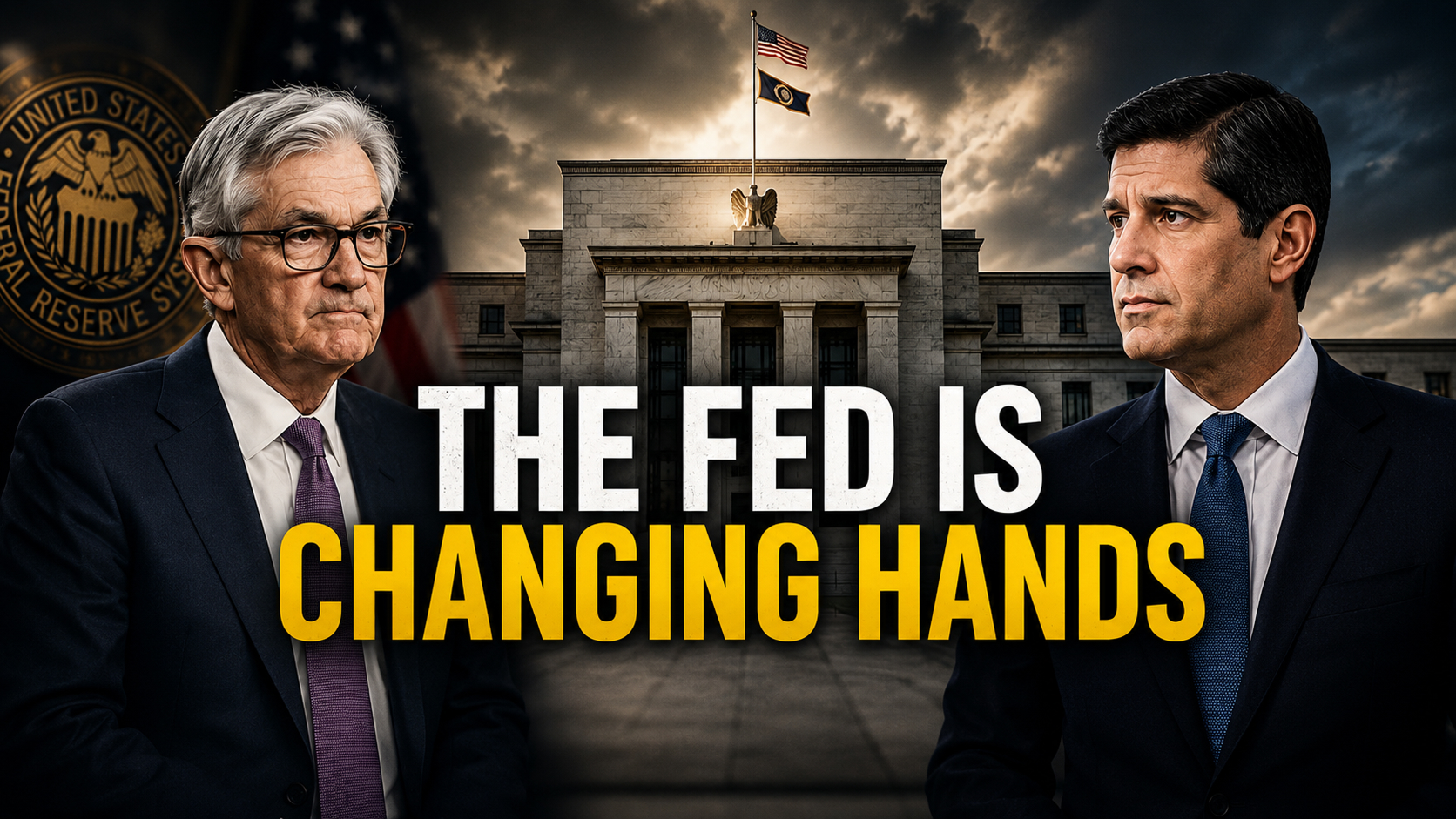
Jerome Powell's 8-year run ends Friday. Kevin Warsh wants "regime change." Markets are about to find out what that means in practice.
On Friday, May 15, Jerome Powell hands over the keys to the most consequential economic institution in the world. The Federal Reserve has a new boss — almost certainly Kevin Warsh, pending a Senate confirmation vote expected this week — and the transition is unlike any in modern memory.
This isn't a routine changing of the guard. It is, by Warsh's own description, a planned "regime change." And understanding what he actually intends to do — versus what he'll be able to do — is one of the most important things an investor can parse right now.
🏦 Who Is Kevin Warsh?
Warsh, 55, is not your typical Fed chair nominee. He's a former Morgan Stanley M&A banker who joined the Fed at 35 as its youngest-ever governor — appointed by President George W. Bush in 2006, just in time to help manage the 2008 financial crisis. He became Ben Bernanke's liaison to Wall Street during the worst of it, which earned him credibility as a "markets guy" in an institution full of Ph.D. economists.
He left in 2011, spent years as a Hoover Institution fellow and Stanford lecturer, and spent that time sharpening a critique of the modern Fed that he made no effort to soften at his April confirmation hearing.
"Once you let inflation take hold in the economy, it's more expensive and harder to bring it down," he told the Senate Banking Committee. "The fatal policy error going back four or five years is still a legacy we're dealing with. I think that means a regime change in the conduct of policy."
That word — regime — was deliberate. Warsh doesn't want to tweak the Fed. He wants to rebuild how it communicates, how it measures inflation, and how it manages its $6.7 trillion balance sheet.
🔧 The Four Things Warsh Wants to Change
Warsh has been consistent about his agenda. He wants to drop the quarterly "dot plot" — the chart where Fed officials publicly signal where they think rates are heading, which he believes creates market-distorting forward guidance. He wants fewer press conferences and public speeches from Fed officials, arguing the central bank over-communicates. He wants to replace the Fed's preferred inflation benchmark — the core PCE measure — with a "trimmed mean" that strips out the biggest outliers. This isn't just a methodology debate: as of May 2026, official core PCE sits at 3.0%, but the trimmed mean equivalent comes in at roughly 2.3%. By switching the yardstick, Warsh can mathematically declare closer-to-victory on inflation and create the policy justification for rate cuts — without appearing to simply fold to White House pressure. And he wants to shrink the balance sheet significantly.
These are not cosmetic changes. They would alter the way markets read the Fed, the way investors price bonds, and — over time — the level of long-term interest rates Americans pay on mortgages and car loans. CNBC analysis described them as "how he brings down the long-term interest rates that trouble Americans," not as standalone procedural tweaks.
⚠️ One Vote — But the Most Powerful One in the Room
Every investor betting on a dovish Warsh pivot should read this section carefully — but so should every investor betting against him.
Yes, the Fed chair is technically one of twelve voting members of the Federal Open Market Committee. Three regional Fed presidents — Cleveland, Minneapolis, and Dallas — already signaled at the April 29 meeting that they opposed even the language of an easing bias in the statement. That was a direct shot across Warsh's bow before he'd even taken his seat.
But the chair's influence extends far beyond that single vote. The chair controls the Fed's internal staff, sets the agenda for what gets researched and modeled, and — critically — is the only person who speaks for the entire institution publicly. If Warsh decides the dot plot is gone, he can administratively stop including it in the Summary of Economic Projections. He doesn't need a committee vote for that. If he wants fewer Fed officials making public speeches, he can simply set a cultural norm from the top. The "resistance" from regional presidents is real, but Fed chairs historically get what they want through institutional attrition — it just takes longer than markets want to price in.
Former Fed Chair Janet Yellen was blunt about the limits. "I really don't see the FOMC accepting this in the short run," she told reporters. Chicago Fed president Austan Goolsbee warned in February that banking on AI productivity gains to justify lower rates is premature: "You want to be extremely careful. You can overheat the economy easily."
Both of those caveats are real. Neither of them means Warsh is powerless. The more accurate framing is that he's extremely powerful in how he frames the debate, and considerably constrained in how fast he can force a vote.
David Seif, chief economist for developed markets at Nomura, said Powell's decision to stay on the board as a governor — rather than departing entirely — "probably means it will take Warsh a little bit longer to build the consensus he is trying to build." Analysts have described the resulting dynamic as a "two Popes" scenario: a new chair and the old one both seated at the same table.
But Powell's decision to stay isn't just about policy — it's personal and legal. Powell announced on April 29 that he would remain on the Fed Board partly because of what he called "unprecedented" legal attacks from the administration, including a Department of Justice criminal investigation into cost overruns at the Fed's Washington headquarters renovation — a probe he explicitly described as political retaliation for not cutting rates. The DOJ dropped the investigation on April 24, clearing Warsh's path, but Powell said he intends to stay until the matter is "well and truly over, with transparency and finality." That framing means this is a standoff between an outgoing chair who believes his institution was targeted by prosecutors and an incoming chair who was the direct beneficiary of that probe being dropped.
Meanwhile, former Fed economist Claudia Sahm offered a more pointed assessment of the road ahead. "This pressure campaign from the White House on the Fed — I cannot believe it ends with Warsh becoming Fed chair," she told Fortune. "Trump wants to see interest rates lower."
💡 Investor Signal: What Actually Changes on Friday
In the short term — less than most people expect. Warsh cannot unilaterally cut rates, drop the dot plot, or change the inflation framework at his first meeting. Institutional change at the Fed moves slowly, particularly when facing internal resistance from veteran regional presidents who serve long terms and can't be removed.
What does change is the signal. Markets will watch Warsh's first post-meeting press conference — whenever he chooses to hold one — the way they used to parse Greenspan's briefcase. His tone on inflation, his comments on AI productivity, and any hint of how quickly he wants to move will be parsed for microsignals in bond markets within seconds.
The sectors most sensitive to a genuine Warsh-led easing cycle: rate-sensitive financials, homebuilders, utilities, and long-duration growth stocks whose future cash flows get discounted at current rates. The sectors most exposed if inflation stays stubborn and Warsh can't deliver: the same ones.
Paul Tudor Jones, the legendary hedge fund manager, captured the ambiguity well. "For sure you'd be thinking about" rate cuts under Warsh, he told CNBC — "but I think he's going to be constrained." That constraint has a name: Tuesday's CPI report. The data doesn't care who's sitting in the chair.
One metric worth tracking closely this week: the 2-year Treasury yield. It's the bond market's most direct read on where it expects the Fed to take rates over the next 24 months. If the 2-year starts to decouple downward from current Fed rates — even before a single Warsh press conference — that's the bond market placing its bet that Warsh wins the "two Popes" standoff and delivers a rate cut in June regardless of what inflation prints. Watch it the way traders used to watch Greenspan's briefcase. It will tell you more than any press conference will.
Sources
- CNBC — "Analysis: Warsh emerges from a difficult hearing with his Fed 'regime-change' plan intact" (April 21, 2026): https://www.cnbc.com/2026/04/21/kevin-warsh-fed-regime-change-senate-confirmation-hearing.html
- CNBC — "Kevin Warsh hearing takeaways: Trump Fed chair nominee defends finances, says president never demanded rate cuts" (April 21, 2026): https://www.cnbc.com/2026/04/21/kevin-warsh-fed-confirmation-hearing-trump-live-updates.html
- CNBC — "Analysis: What might trip up Kevin Warsh and his agenda as Fed chair" (March 27, 2026): https://www.cnbc.com/2026/03/27/analysis-what-might-trip-up-kevin-warsh-and-his-agenda-as-fed-chair.html
- CNBC — "Trump Fed pick Kevin Warsh clears key Senate hurdle, teeing up final vote" (April 29, 2026): https://www.cnbc.com/2026/04/29/trump-fed-nominee-kevin-warsh-senate-approval.html
- Fortune — "'This is not normal': Former Fed economist sounds alarm on Kevin Warsh after one-sided confirmation" (April 30, 2026): https://fortune.com/2026/04/30/kevin-warsh-claudia-sahm-partisanship-donald-trump-nomination-vote-jerome-powell/
- CBS News — "Senate Banking Committee advances Kevin Warsh's nomination for Fed chair" (April 29, 2026): https://www.cbsnews.com/news/senate-banking-committee-vote-kevin-warsh-federal-reserve/
- Kiplinger — "Kevin Warsh Fed Chair Nomination: Live Updates and Commentary" (May 2026): https://www.kiplinger.com/news/live/kevin-warsh-fed-nomination
- TheStreet — "Incoming Fed Chair Warsh's rate cut path is on a collision course with White House" (May 2026): https://www.thestreet.com/economy/bullish-investors-eye-clarity-onkevin-warsh-fed-rate-cut-path
- Al Jazeera — "Senate panel advances Kevin Warsh's nomination for US Fed chair" (April 29, 2026): https://www.aljazeera.com/economy/2026/4/29/senate-panel-advances-kevin-warshs-nomination-for-us-fed-chair
Market Munchies and Mode Mobile communications are for informational purposes only, and are not a recommendation, solicitation, or research report relating to any investment strategy, security, or digital asset. All investments involve risk including the loss of principal and past performance does not guarantee future results.
Any information contained in this commentary does not purport to be a complete description of the securities, markets, or developments referred to in this material. The information has been obtained from sources considered to be reliable, but we do not guarantee that the foregoing material is accurate or complete. There is no guarantee that any statements or opinions provided herein will prove to be correct.