
The U.S. Just Sanctioned Iranian Oil Networks Before Trump's Beijing Summit. Here's What That Move Signals.
Trump Leaves for China Today. The Sanctions Arrived First. Here's Why the Timing Matters. What you need to know before reading: The U.S. blacklisted 12 firms for helping Iran sell oil to China — announced today, the day Trump departs for Beijing Trump arrives Beijing Wednesday…
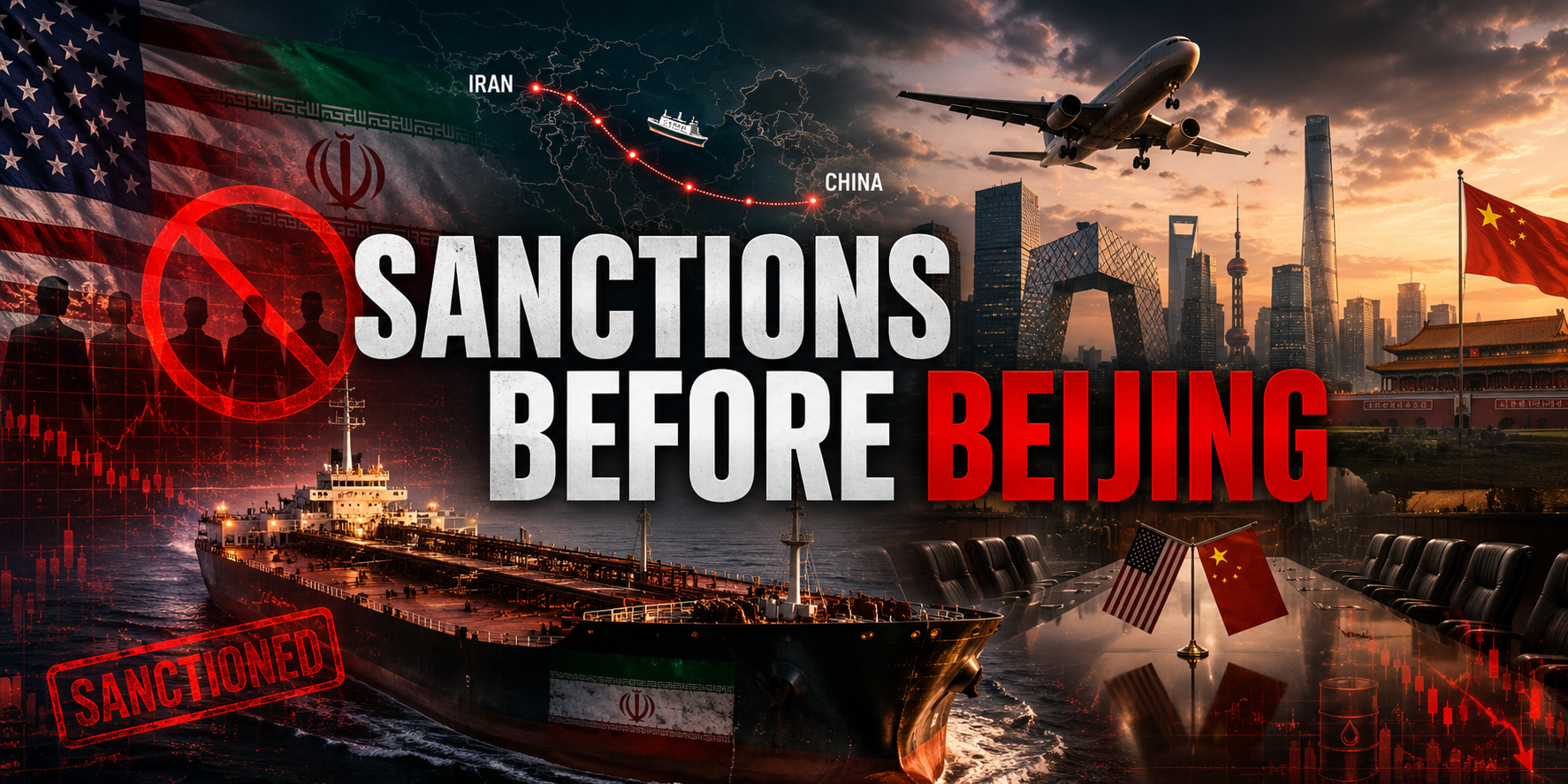
Trump Leaves for China Today. The Sanctions Arrived First. Here's Why the Timing Matters.
What you need to know before reading:
- The U.S. blacklisted 12 firms for helping Iran sell oil to China — announced today, the day Trump departs for Beijing
- Trump arrives Beijing Wednesday evening; formal summit meetings with Xi are Thursday-Friday May 14-15
- China buys more than 80% of Iran's exported oil — making it the central variable in any Hormuz resolution
- The sanctions could be leverage before negotiating, or a provocation that poisons the talks — analysts are genuinely split
The timing is not subtle. One day before Donald Trump boards Air Force One for Beijing, the U.S. Treasury Department blacklisted 12 firms and individuals — including entities based in Hong Kong, the UAE, and Oman — for allegedly facilitating the sale and shipment of Iranian oil on behalf of the Islamic Revolutionary Guard Corps.
Treasury Secretary Scott Bessent framed it in maximalist language: the agency will "continue to cut the Iranian regime off from the financial networks it uses to carry out terrorist acts and to destabilize the global economy."
What he did not say is that the sanctions land on the same day Trump departs for a state visit with the leader of the country buying most of that oil.
Trump arrives in Beijing Wednesday evening. The formal summit meetings with Xi begin Thursday morning, May 14. The next two days could tell investors whether this is a pressure campaign with an exit ramp, or just another escalation in a pattern that has been running for years.
🛢️ The Iran-China Oil Relationship in Numbers
- Before understanding what the sanctions mean, it helps to understand the scale of what they're targeting.This is not a new dynamic. The U.S. has been sanctioning Chinese entities for Iranian oil purchases since at least 2019. What is new is the scale, the urgency, and the specific timing against a summit that is supposed to improve the bilateral relationship.In April, the U.S. Treasury sanctioned Chinese independent refinery Hengli Petrochemical for buying billions of dollars' worth of Iranian oil — the first time Washington made good on its threats to go after major buyers rather than just intermediaries. It also sent letters to two Chinese banks warning of secondary sanctions if they facilitated Iranian oil trade.Beijing pushed back immediately. China's Ministry of Commerce ordered companies not to comply with U.S. sanctions against five Chinese refiners — the first time it invoked a law allowing it to retaliate against entities enforcing sanctions it deems unlawful.Monday's 12-company action is the next move in that sequence. The question is whether it is designed to create leverage or simply register displeasure — and those are meaningfully different things.
- 80%+ of Iran's exported oil goes to China
- 1.38 million barrels per day — China's average Iranian oil purchases in 2025, per Kpler
- $50B+ in estimated annual revenue flowing to Tehran through Chinese buyers
- This is Iran's primary financial lifeline through the war and the Hormuz closure
⚡ Leverage or Provocation? Both Readings Are Defensible.
Before major bilateral meetings, the U.S. has historically used sanctions or tough rhetoric to arrive at the negotiating table from a position of strength rather than need. Monday's action could be designed to make Beijing more willing to cooperate on Hormuz reopening in exchange for sanctions relief — a framework that has worked, imperfectly, before.
A Chinese government analyst quoted in Asian media offered the counterreading bluntly: "using Iran-related issues to sanction Chinese entities reflects the same game-playing mentality" and would "not achieve its intended purpose and will instead damage the foundation of mutual trust."
Both views have merit. U.S. pre-summit pressure campaigns often achieve both effects simultaneously: creating negotiating leverage while also irritating the counterpart. The key question is not whether Beijing is annoyed — it will be — but whether it concludes that cooperation on Iran is worth more to it than defiance.
Nomura's chief China economist Ting Lu offered a useful framing in a Monday note: "In our view, the summit will be more about avoiding an unnecessary escalation of tensions and managing risks than building up structural mechanisms and forging deep friendships." That is probably the right baseline — not a historic breakthrough, but a managed pause.
🇨🇳 What Each Side Wants
China's position: Genuinely complex. It has been buying discounted Iranian oil in defiance of U.S. sanctions — a net economic benefit. It brokered Iran's participation in Pakistan peace talks last month. It hosted Iran's foreign minister last week. It has publicly called for a "complete cessation of hostilities." Beijing is Iran's most important economic partner and is not going to simply walk away from that relationship on Washington's request alone.
The U.S. ask: Treasury Secretary Bessent has publicly urged China to "join us in this international operation" to open the Strait of Hormuz. That is a significant request — the U.S. is effectively inviting China to align against a country Beijing has cultivated as a strategic energy partner for years.
The price of cooperation: Beijing's help on Iran would likely come with something in return — whether trade concessions, export-control flexibility, diplomatic assurances, or a broader package letting both sides claim a win. Reuters reports the two sides are also working on a proposed Board of Trade mechanism to expand bilateral commerce without weakening national security. That mechanism is the infrastructure through which any Iran bargain might flow.
Whether Beijing accepts, declines, or finds a middle path is the central question of the next 48 hours.
🏗️ What Would a Deal Actually Look Like?
A China-U.S. Iran framework — in which China reduces Iranian oil purchases in exchange for meaningful U.S. concessions — is not the most likely result of a two-day visit. But it is one of the outcomes that would move markets most significantly.
Brent crude is trading around $107 to $108 this morning, elevated by the ongoing Hormuz disruption. A credible signal that China is willing to reduce Iranian oil purchases would give markets a clearer framework for pricing in a Hormuz reopening timeline. A summit that produces no Iran agreement and worsening rhetoric would likely push oil higher.
Watch the Board of Trade mechanism specifically. Reuters reports both sides are negotiating this infrastructure for expanding bilateral commerce. If it appears in any summit communiqué language, investors will have a clearer view of how Iran oil could become part of a broader U.S.-China bargain. If it doesn't, the sanctions announced Monday were likely just another move in the same long-running pattern.
💼 What Investors Should Watch
Oil: Brent around $107 to $108. A credible China-Iran decoupling signal from the summit — even a vague one — would be taken by markets as a Hormuz reopening signal and would push crude lower. A summit that ends with no Iran agreement and sharper rhetoric would likely push it higher.
The sanctioned entities: The 12 firms and individuals blacklisted Monday cannot conduct business with U.S. entities and have any U.S.-jurisdiction assets frozen. For investors in Hong Kong-listed companies with exposure to Iranian oil logistics, the sanction list is worth reviewing for counterparty risk.
China tech and trade names: A successful Board of Trade negotiation would be positive for U.S. exporters — agriculture, Boeing specifically, and energy — if the summit produces meaningful purchase commitments. Any AI or semiconductor concessions extracted by Washington in exchange would be worth monitoring for China-exposed technology names.
The offshore yuan: A summit that meaningfully reduces U.S.-China tension would be expected to strengthen the yuan against the dollar. Watch the CNH rate through Wednesday and Thursday as the meetings proceed. A sharp move in either direction will be the market's real-time verdict on how the talks are going.
Trump lands in Beijing Wednesday evening. The formal meetings begin Thursday morning. By Friday afternoon, markets will know whether the sanctions were an opening bid or a dead end.
Sources
- Bloomberg — "Iran Oil Exports to China Draw New US Sanctions on 12 Companies": https://www.bloomberg.com/news/articles/2026-05-11/us-sanctions-twelve-entities-for-sales-of-iranian-oil-to-china
- CNN — "Trump administration imposes sanctions on 12 companies for facilitating Iranian oil sales to China": https://edition.cnn.com/2026/05/11/world/live-news/iran-war-proposal-trump
- CNBC — "Five things to watch in Asia as Trump prepares to meet China's Xi this week": https://www.cnbc.com/2026/05/12/tump-xi-china-summit-taiwan-iran-trade.html
- Detroit News / Reuters — "Iran war top issue for US and China ahead of Trump-Xi talks": https://www.detroitnews.com/story/news/world/2026/05/11/iran-war-strains-ties-ahead-of-trump-and-xi-jinping-summit/90027633007/
- SCMP — "China confirms dates for Donald Trump's state visit to Beijing": https://www.scmp.com/news/china/diplomacy/article/3353075/china-confirms-dates-donald-trumps-state-visit-beijing
- Asia Times — "New Trump sanctions on Chinese firms: leverage on Xi or overkill?": https://asiatimes.com/2026/05/maybe-overkill-new-sanctions-show-trump-hope-for-xi-help-on-iran/
- CSIS — "Trump-Xi 2026 Summit": https://www.csis.org/programs/trump-xi-2026-summit
Market Munchies and Mode Mobile communications are for informational purposes only, and are not a recommendation, solicitation, or research report relating to any investment strategy, security, or digital asset. All investments involve risk including the loss of principal and past performance does not guarantee future results.
Any information contained in this commentary does not purport to be a complete description of the securities, markets, or developments referred to in this material. The information has been obtained from sources considered to be reliable, but we do not guarantee that the foregoing material is accurate or complete. There is no guarantee that any statements or opinions provided herein will prove to be correct.